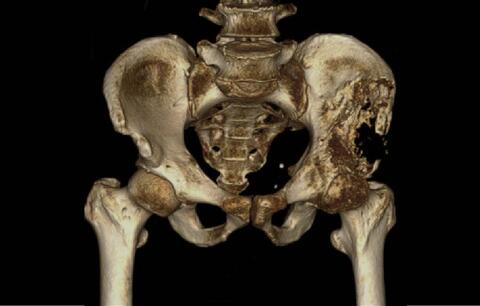
Focusing on the interplay between bone quality and geometry, this area develops quantitative, CT-based computational models to predict fracture risk in bones compromised by neoplastic or metabolic conditions. Novel algorithms are created to analyze serial, trans-axial CT images, calculating the minimal structural rigidity by identifying the bone’s weakest segment. This technique integrates both the material properties and geometric dimensions of bone to assess its load-bearing capacity, which has proven valuable in diverse scenarios—from benign skeletal lesions to metastatic cancer and even skeletal dysplasias like those observed in Hutchinson-Gilford progeria syndrome. The resulting predictive models enhance clinical decision-making by offering objective, reproducible criteria for surgical planning and treatment monitoring.