

Our Research
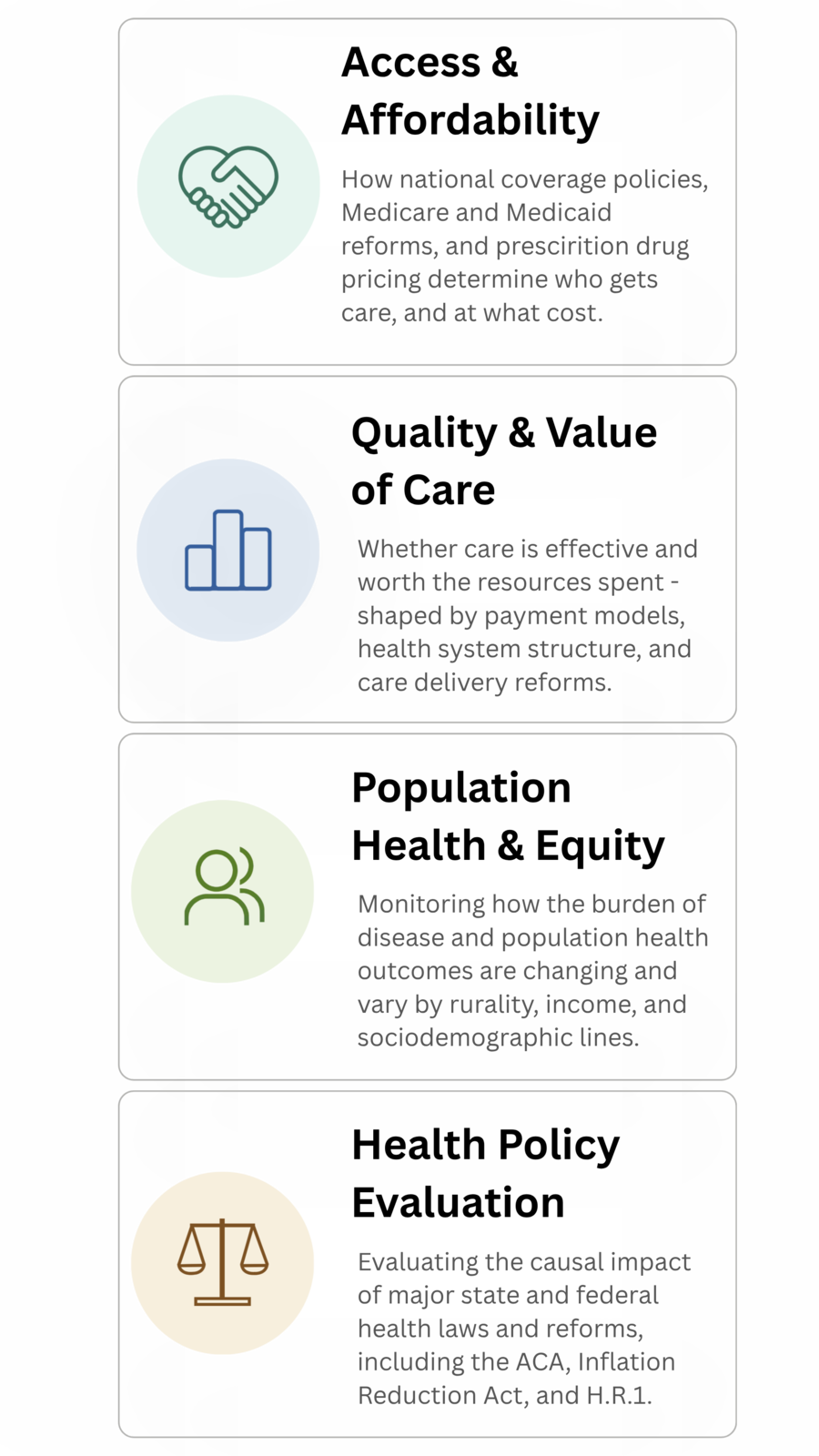
Our research examines how health policies, reforms, and systems shape health care access and affordability, quality, and population health outcomes across the United States. We use state-of-the-science methods to produce rigorous, actionable evidence — holding policy to the same evidentiary standards we demand of clinical medicine. From the design of national value-based payment programs under the Affordable Care Act, to the structure of Medicare and Medicaid, to safety-net programs and policies making prescription drugs and health care more affordable (such as the Inflation Reduction Act), our work touches the policies that shape health care for millions of Americans.
Our section is led by Dr. Rishi Wadhera, a nationally recognized cardiologist, health policy researcher, and outcomes scientist. Our findings are frequently published in leading medical journals, including the New England Journal of Medicine, JAMA, and The Lancet, and have been cited in Congressional reports, Senate testimonies, MedPAC reports, American College of Cardiology/American Heart Association clinical practice guidelines, and by senior leaders at the Centers for Medicare and Medicaid Services. Our work has directly influenced federal health policy — research from our group demonstrating the unintended consequences of pay-for-performance policies, for example, has helped reshape how these initiatives are designed, implemented, and evaluated on a national scale.
Our research is also regularly covered in the New York Times, NPR, NBC News, and STAT News. Alongside this research mission, we are deeply committed to training the next generation of physician-scientists and health policy researchers.
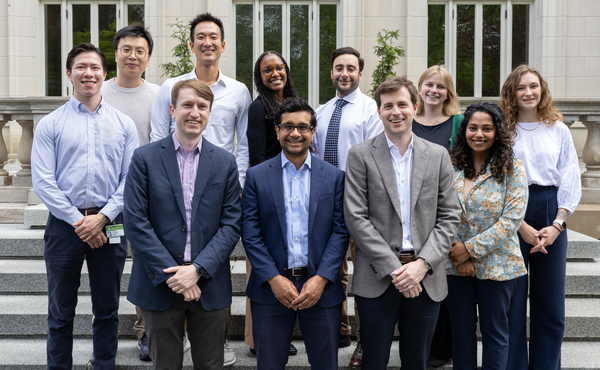
Rishi K. Wadhera, MD, MPP, MPhil
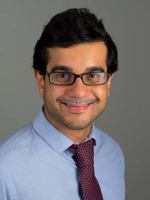
Rishi K. Wadhera, MD, MPP, MPhil is a cardiologist, health policy researcher, and Associate Professor at Harvard Medical School and the Harvard T.H. Chan School of Public Health. He serves as Associate Director of the Smith Center for Outcomes Research, where he founded the Section of Health Policy Research, building it into a large, multidisciplinary team of 15 full-time clinician-investigators, research staff, and postdoctoral fellows. He is an elected member of the American Society of Clinical Investigation. Dr. Wadhera's research program applies the evidentiary rigor of clinical medicine to the evaluation of health policy, asking not just what policies intend, but how they actually affect patients. He is the principal investigator of three NIH R01 grants and a recipient of the American Heart Association Established Investigator Award, and has authored more than 280 peer-reviewed publications in leading medical journals. He has advised senior leaders at the US Department of Health and Human Services, the Centers for Medicare and Medicaid Services, and Congressional committees, and is widely cited as a health policy expert by the New York Times, NPR, the Boston Globe, and NBC News. He serves as Associate Editor at the Journal of the American College of Cardiology and on standing advisory panels for the Institute for Clinical and Economic Review and the National Committee for Quality Assurance. A defining feature of his work is mentorship and faculty development. He has trained more than 40 junior investigators who have collectively first-authored more than 110 publications and secured competitive career development awards, with many advancing to independent academic careers across the country.

167
Publications
Faculty as first or senior author

63%
High Impact
Lancet • JAMA • NEJM • BMJ

122
Trainee Papers
first-author trainee publications

47
Trainees
From 21 institutions
Selected Publications

Health effects of reductions in food assistance benefits in the USA
Prihatha Narasimmaraj, Bella Qian, Jose Figueroa, Sara Naomi Bleich, Rishi K Wadhera
Medication Adherence Among Medicare Beneficiaries With Cardiovascular Conditions After the 2024 Inflation Reduction Act Provisions
Lucas Marinacci, Andrew Oseran, Prihatha Narasimmaraj, Eden Engel-Rebitzer, Rishi K Wadhera.
Cardiovascular Statistics in the United States, 2026
Rishi K Wadhera RK, Sanket Dhruva, Behnood Bikdeli, Marc Bonaca , Michelle Kittleson , Dennis Ko, Yuan Lu , Neha Pagidipati , Mitsuaki Sawano, Erica Spatz, et al.

Insurance Coverage and Employment after Medicaid Expansion with Work Requirements: Quasi-experimental difference-in-differences study
Daniel Johnson*, Stephen Mein*, Lucas Marinacci, Michael Liu, Rishi K Wadhera

Changes in Physical and Mental Health After the End of SNAP Emergency Allotments
Michael Liu, Daniel Y Johnson, Sara N Bleich, Prihatha R Narasimmaraj, Camilla Bjorck-Posson, Jose Figueroa, Rishi K Wadhera
Cardiovascular Deaths During the COVID-19 Pandemic in the United States
Rishi K Wadhera, Changyu Shen, Suhas Gondi, Siyan Chen, Dhruv S Kazi, Robert W Yeh
Changes in Patient Care Experience After Private Equity Acquisition of US Hospitals
Anjali Bhatla, Victoria L Bartlett, Michael Liu, ZhaoNian Zheng, Rishi K Wadhera
Cardiovascular Health of Middle-Aged U.S. Adults by Income Level, 1999 to March 2020: A Serial Cross-Sectional Study
Michael Liu, Rahul Aggarwal, ZhaoNian Zheng, Robert Yeh, Dhruv S Kazi, Karen E Joynt Maddox, Rishi K Wadhera
Financial Burden of Health Care in the Privately Insured
US Population
Sukruth A Shashikumar, ZhaoNian Zheng, Karen E Joynt Maddox, Rishi K Wadhera
Out-of-Pocket Drug Costs for Medicare Beneficiaries With Cardiovascular Risk Factors Under the Inflation Reduction Act
Prihatha R Narasimmaraj, Andrew Oseran, Archana Tale, Jiaman Xu, Utibe R Essien, Dhruv Kazi, Robert W Yeh, Rishi K Wadhera
Health Equity Adjustment and Hospital Performance in the Medicare Value-Based Purchasing Program
Michael Liu, Sahil Sandhu, Karen E Joynt Maddox, Rishi K Wadhera
Private Equity Acquisitions of Outpatient Cardiology Practices in the United States, 2013-2023
Victoria Bartlett, Michael Liu, Shylie Ati, Robert Yeh, ZhaoNian Zheng, Rishi K Wadhera
Selected Media

-
RT @BidmcCvi: Health Policy in Motion: From Rigorous Evidence to Real-World Impact - Watch recent #BIDMC CV grand rounds by @SmithBIDMC Dir…

-
RT @SmithBIDMC: Final call!📣 We’ve extended the deadline for the Zimetbaum Fellowship to October 30th! Are you a med student/resident int…
-
RT @BIDMCVFellows: Huge congrats to our first year cardiology fellow @PeterBrodeurMD, @AdamRodmanMD & the @Google team on the first prosp…