
Despite increasing cesarean rates in Africa, there remain extensive gaps in the standard provision of care after cesarean birth. We present recommendations for discharge instructions to be provided to women following cesarean delivery in Rwanda, particularly rural Rwanda, and with consideration of adaptable guidelines for sub-Saharan Africa, to support recovery during the postpartum period. These guidelines were developed by a Technical Advisory Group comprised of clinical, program, policy, and research experts with extensive knowledge of cesarean care in Africa. The final instructions delineate between normal and abnormal recovery symptoms and advise when to seek care. The instructions align with global postpartum care guidelines, with additional emphasis on care practices more common in the region and address barriers that women delivering via cesarean may encounter in Africa. The recommended timeline of postpartum visits and visit activities reflect the World Health Organization protocols and provide additional activities to support women who give birth via cesarean. These guidelines aim to standardize communication with women at the time of discharge after cesarean birth in Africa, with the goal of improved confidence and clinical outcomes among these individuals.
Publications by Year: 2023
2023
OBJECTIVE: To assess trends in childbirth at a hospital-birth center among women living in Compañeros En Salud (CES)-affiliated communities in Chiapas, Mexico and explore barriers to childbirth care. Our hypothesis was that despite interventions to support and incentivize childbirth at the hospital-birth center, the proportion of births at the hospital-birth center among women from Compañeros En Salud-affiliated communities has not significantly changed after two years. We suspected that this may be due to structural factors impacting access to care and/or perceptions of care impacting desire to deliver at the birth center.
DESIGN: This explanatory mixed-methods study included a retrospective Compañeros En Salud maternal health census review followed by quantitative surveys and semi-structured qualitative interviews.
PARTICIPANTS AND SETTING: Participants were women living in municipalities in the mountainous Sierra Madre region of Chiapas, Mexico who received prenatal care in one of 10 community clinics served by Compañeros En Salud. Participants were recruited if they gave birth anywhere other than the primary-level rural hospital and adjacent birth center supported by Compañeros En Salud, either at home or at other facilities.
MEASUREMENTS: We compared rates of birth at the hospital-birth center, other health facilities, and at home from 2017-2018. We conducted surveys and interviews with women who gave birth between January 2017-July 2018 at home or at facilities other than the hospital-birth center to understand perceptions of care and decision-making surrounding childbirth location.
FINDINGS: We found no significant difference in rates of overall number of women birthing at the hospital-birth center from Compañeros En Salud-affiliated communities between 2017 and 2018 (p=0.36). Analysis of 158 surveys revealed distance (30.4%), time (27.8%), and costs (25.9%) as reasons for not birthing at the hospital-birth center. From 27 interviews, negative perceptions and experiences of the hospital included low-quality and disrespectful care, low threshold for medical interventions, and harm and suffering. Partners or family members influenced most decisions about childbirth location.
KEY CONCLUSIONS: Interventions to minimize logistical barriers may not be sufficient to overcome distance and perceptions of low-quality, disrespectful care.
IMPLICATIONS FOR PRACTICE: Better understanding of complex decision-making around childbirth will guide Compañeros En Salud in developing interventions to further meet the needs and preferences of birthing women in rural Chiapas.
BACKGROUND: Public health and clinical recommendations are established from systematic reviews and retrospective meta-analyses combining effect sizes, traditionally, from aggregate data and more recently, using individual participant data (IPD) of published studies. However, trials often have outcomes and other meta-data that are not defined and collected in a standardized way, making meta-analysis problematic. IPD meta-analysis can only partially fix the limitations of traditional, retrospective, aggregate meta-analysis; prospective meta-analysis further reduces the problems.
METHODS: We developed an initiative including seven clinical intervention studies of balanced energy-protein (BEP) supplementation during pregnancy and/or lactation that are being conducted (or recently concluded) in Burkina Faso, Ethiopia, India, Nepal, and Pakistan to test the effect of BEP on infant and maternal outcomes. These studies were commissioned after an expert consultation that designed recommendations for a BEP product for use among pregnant and lactating women in low- and middle-income countries. The initiative goal is to harmonize variables across studies to facilitate IPD meta-analyses on closely aligned data, commonly called prospective meta-analysis. Our objective here is to describe the process of harmonizing variable definitions and prioritizing research questions. A two-day workshop of investigators, content experts, and advisors was held in February 2020 and harmonization activities continued thereafter. Efforts included a range of activities from examining protocols and data collection plans to discussing best practices within field constraints. Prior to harmonization, there were many similar outcomes and variables across studies, such as newborn anthropometry, gestational age, and stillbirth, however, definitions and protocols differed. As well, some measurements were being conducted in several but not all studies, such as food insecurity. Through the harmonization process, we came to consensus on important shared variables, particularly outcomes, added new measurements, and improved protocols across studies.
DISCUSSION: We have fostered extensive communication between investigators from different studies, and importantly, created a large set of harmonized variable definitions within a prospective meta-analysis framework. We expect this initiative will improve reporting within each study in addition to providing opportunities for a series of IPD meta-analyses.
There is growing evidence that language discordance between patients and their health care teams negatively affects quality of care, experience of care, and health outcomes, yet there is limited guidance on best practices for advancing equitable care for patients who have language barriers within obstetrics and gynecology. In this commentary, we present two cases of language-discordant care and a framework for addressing language as a critical lens for health inequities in obstetrics and gynecology, which includes a variety of clinical settings such as labor and delivery, perioperative care, outpatient clinics, and inpatient services, as well as sensitivity around reproductive health topics. The proposed framework explores drivers of language-related inequities at the clinician, health system, and societal level. We end with actionable recommendations for enhancing equitable care for patients experiencing language barriers. Because language and communication barriers undergird other structural drivers of inequities in reproductive health outcomes, we urge obstetrician-gynecologists to prioritize improving care for patients experiencing language barriers.
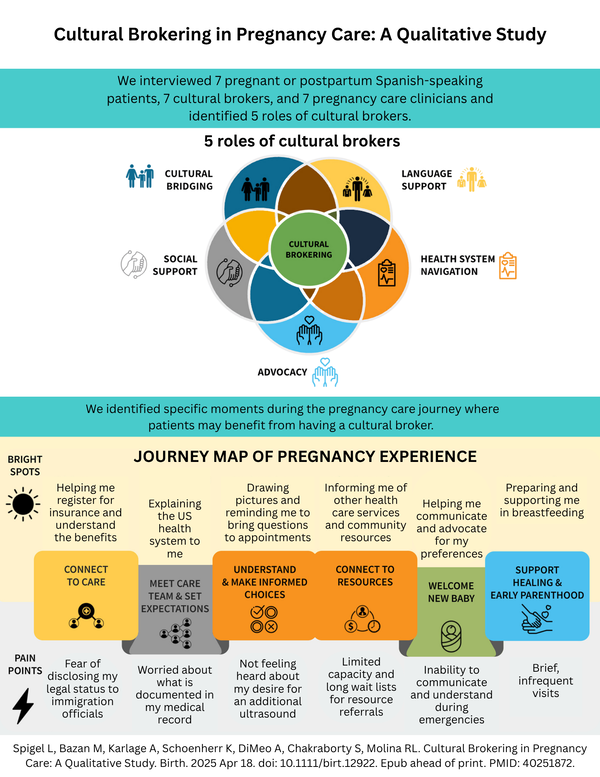
People who speak languages other than English face structural barriers in accessing the US healthcare system. With a growing number of people living in countries other than their countries of birth, the impact of language and cultural differences between patients and care teams on quality care is global. Cultural brokering presents a unique opportunity to enhance communication and trust between patients and clinicians from different cultural backgrounds during pregnancy care-a critical window for engaging families in the healthcare system. This critical review aims to synthesize literature describing cultural brokering in pregnancy care. We searched keywords relating to cultural brokering, pregnancy, and language in PubMed, Embase, and CINAHL and traced references of screened articles. Our search identified 33 articles. We found that cultural brokering is not clearly defined in the current literature. Few of the articles provided information about language concordance between cultural brokers and patients or clinicians. No article described the impact of cultural brokering on health outcomes. Facilitators of cultural brokering included: interprofessional collaboration within the care team, feeling a family connection between the cultural broker and patients, and cultivating trust between the cultural broker and clinicians. Barriers to cultural brokering included: misunderstanding the responsibilities, difficulty maintaining personal boundaries, and limited availability and accessibility of cultural brokers. We propose cultural brokering as interactions that cover four key aims: (1) language support; (2) bridging cultural differences; (3) social support and advocacy; and (4) navigation of the healthcare system. Clinicians, researchers, and policymakers should develop consistent language around cultural brokering in pregnancy care and examine the impact of cultural brokers on health outcomes.
Reproductive coercion extends from a historical context in which the obstetrics and gynecology profession has interfered with the reproductive and bodily autonomy of immigrants. We provide illustrative examples of historical and contemporary immigration policies that allow mechanisms of reproductive control to persist within the immigration detention system. We end by compelling obstetrician-gynecologists to act as agents of change by leveraging their social, economic, and political power to resist and eliminate structures and norms that enable reproductive oppression of immigrant groups in detention.
OBJECTIVE: To explore Spanish-speaking patients' experiences and preferences regarding communication during pregnancy care with specific attention to language barriers.
METHODS: Patients with a Spanish language preference who gave birth between July 2022 and February 2023 at an academic medical center were invited to participate in focus groups. Focus groups were held over Zoom, audio-recorded, transcribed in Spanish, translated into English, and reviewed for translation accuracy. Thematic analysis was conducted with deductive and inductive approaches. Three investigators double-coded all transcripts, and discrepancies were resolved through team consensus.
RESULTS: Seven focus groups (27 total participants, range 2-6 per group) were held. Three key themes emerged regarding patient experiences and communication preferences when seeking pregnancy care: 1) language concordance and discordance between patients and clinicians are not binary-they exist on a continuum; 2) language-discordant care is common and presents communication challenges, even with qualified interpreters present; and 3) language discordance can be overcome with positive interpersonal dynamics between clinicians and patients.
CONCLUSION: Our findings highlight the importance of relationship to overcome language discordance among patients with limited English proficiency during pregnancy care. These findings inform potential structural change and patient-clinician dyad interventions to better meet the communication needs of patients with limited English proficiency.


