
Publications by Year: 2024

2024

Rivera L, Butler H, Salinas KE, et al. Communication Preferences During Pregnancy Care Among Patients With Primary Spanish Language: A Scoping Review.. Women’s health issues : official publication of the Jacobs Institute of Women’s Health. 2024;34(2):164-171. doi:10.1016/j.whi.2023.08.008

BACKGROUND: Qualified language service providers (QLSPs)-professional interpreters or multilingual clinicians certified to provide care in another language-are critical to ensuring meaningful language access for patients. Designing patient-centered systems for language access could improve quality of pregnancy care.

OBJECTIVE: We synthesized and identified gaps in knowledge about communication preferences during pregnancy care among patients with Spanish primary language.

METHODS: We performed a scoping review of original research studies published between 2000 and 2022 that assessed communication preferences in Spanish-speaking populations during pregnancy care. Studies underwent title, abstract, and full-text review by three investigators. Data were extracted for synthesis and thematic analysis.

RESULTS: We retrieved 1,539 studies. After title/abstract screening, 36 studies underwent full-text review, and 13 of them met inclusion criteria. Two additional studies were included after reference tracing. This yielded a total of 15 studies comprising qualitative (n = 7), quantitative (n = 4), and mixed-methods (n = 4) studies. Three communication preference themes were identified: language access through QLSPs (n = 7); interpersonal dynamics and perceptions of quality of care (n = 9); and information provision and shared decision-making (n = 8). Although seven studies reported a strong patient preference to receive prenatal care from Spanish-speaking clinicians, none of the included studies assessed clinician Spanish language proficiency or QLSP categorization.

CONCLUSIONS: Few studies have assessed communication preferences during pregnancy care among patients with primary Spanish language. Future studies to improve communication during pregnancy care for patients with primary Spanish language require intentional analysis of their communication preferences, including precision regarding language proficiency among clinicians.
Bolt LM, Jiménez EH, Molina RL, Schreier AL. Conservation education initiatives for elementary school students at La Suerte Biological Research Station, Costa Rica.. Folia primatologica; international journal of primatology. 2024;95(4-6):271-281. doi:10.1163/14219980-bja10020

Maderas Rainforest Conservancy (MRC) is a conservation non-profit organization that protects forests, offers primate field schools, and leads community outreach initiatives at sites in Central America, including La Suerte Biological Research Station (LSBRS) in Costa Rica. In 2018, MRC started Aula Verde, a conservation education initiative for elementary school students aged 5-12 at LSBRS. Groups of children from elementary schools and communities located within 50 km have visited LSBRS from 2018-2023 to participate in the 1.5-2 hour Aula Verde workshop, which consists of (1) an interactive lecture on conservation, (2) a guided forest walk, and (3) a snack, gift bag, and tree seedling for each participant. Workshops are funded by international donations to MRC and cost US $8-16 per student. Aula Verde has been successful, with multiple schools and communities making repeat visits, students' families beginning to recycle their garbage and joining a WhatsApp group about conservation education that MRC staff initiated and lead, and teachers reporting improved learning outcomes for students who participate in the workshops. The success of Aula Verde is largely due to the ecological expertise and strong community ties of LSBRS staff. While the COVID-19 pandemic decreased Aula Verde offerings from 2020-2023, we expect workshops to resume at full capacity in 2024. In the future, MRC hopes to expand Aula Verde's outreach to all children aged 5-12 living within 50 km of LSBRS.

Chen YW, Kim TD, Molina RL, Chang DC, Oseni TO. Minority-Serving Hospitals Are Associated With Low Within-Hospital Disparity.. The American surgeon. 2024;90(4):567-574. doi:10.1177/00031348231175117

BACKGROUND: Disparities in obstetric care have been well documented, but disparities in the within-hospital population have not been as extensively explored. The objective is to assess cesarean delivery rate disparities at the hospital level in a nationally recognized low risk of cesarean delivery group.

METHODS: An observational study using a national population-based database, Nationwide Inpatient Sample, from 2008 to 2011 was conducted. All patients with nulliparous, term, singleton, vertex pregnancies from Black and White patients were included. The primary outcome was delivery mode (cesarean vs vaginal). The primary independent variable was race (Black vs White).

RESULTS: A total of 1,064,351 patients were included and the overall nulliparous, term, singleton, and vertex pregnancies cesarean delivery rate was 14.1%. The within-hospital disparities of cesarean delivery rates were lower in minority-serving hospitals (OR: 1.20 95% CI: 1.12-1.28), rural hospitals (OR 1.11 95% CI: 1.02-1.20), and the South (OR 1.24 95% CI 1.19-1.30) compared to their respective counterparts. Non-minority serving hospitals (OR: 1.20 95% CI 0.12-1.25), and urban hospitals (OR1.32 95% CI 1.28-1.37), the Northeast (OR 1.41 95% CI 1.30-1.53) or West (OR 1.52 95% CI 1.38-1.67), had higher within-hospital racial disparities of cesarean delivery rates. The odds ratios reported are comparing within-hospital cesarean delivery rates in Black and White patients.

DISCUSSION: Significant within-hospital disparities of cesarean delivery rates across hospitals highlight the importance of facility-level factors. Policies aimed at advancing health equity must address hospital-level drivers of disparities in addition to structural racism.

Gama ZA da S, de Lima MTS, Semrau KEA, et al. Implementation of the WHO Safe Childbirth Checklist: a scoping review protocol.. BMJ open. 2024;14(5):e084583. doi:10.1136/bmjopen-2024-084583

INTRODUCTION: The WHO Safe Childbirth Checklist (WHO SCC) was developed to accelerate adoption of essential practices that prevent maternal and neonatal morbidity and mortality during childbirth. This study aims to summarise the current landscape of organisations and facilities that have implemented the WHO SCC and compare the published strategies used to implement the WHO SCC implementation in both successful and unsuccessful efforts.

METHODS AND ANALYSIS: This scoping review protocol follows the guidelines of the Joanna Briggs Institute. Data will be collected and reported according to the Preferred Reporting Items for Systematic Reviews and Meta-Analyses extension for Scoping Reviews report. The search strategy will include publications from the databases Scopus, PubMed, Embase, CINAHL and Web of Science, in addition to a search in grey literature in The National Library of Australia's Trobe, DART-Europe E-Theses Portal, Electronic Theses Online Service, Theses Canada, Google Scholar and Theses and dissertations from Latin America. Data extraction will include data on general information, study characteristics, organisations involved, sociodemographic context, implementation strategies, indicators of implementation process, frameworks used to design or evaluate the strategy, implementation outcomes and final considerations. Critical analysis of implementation strategies and outcomes will be performed with researchers with experience implementing the WHO SCC.

ETHICS AND DISSEMINATION: The study does not require an ethical review due to its design as a scoping review of the literature. The results will be submitted for publication to a scientific journal and all relevant data from this study will be made available in Dataverse.

TRIAL REGISTRATION NUMBER: https://doi.org/10.17605/OSF.IO/RWY27.

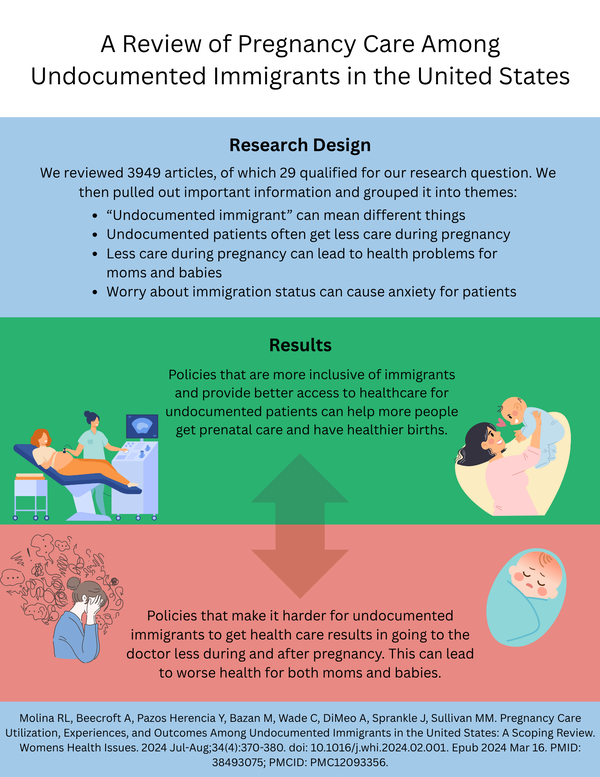
Molina RL, Beecroft A, Herencia YP, et al. Pregnancy Care Utilization, Experiences, and Outcomes Among Undocumented Immigrants in the United States: A Scoping Review.. Women’s health issues : official publication of the Jacobs Institute of Women’s Health. 2024;34(4):370-380. doi:10.1016/j.whi.2024.02.001

BACKGROUND: Undocumented immigrants face many barriers in accessing pregnancy care, including language differences, implicit and explicit bias, limited or no insurance coverage, and fear about accessing services. With the national spotlight on maternal health inequities, the current literature on undocumented immigrants during pregnancy requires synthesis.

OBJECTIVE: We aimed to describe the literature on pregnancy care utilization, experiences, and outcomes of undocumented individuals in the United States.

METHODS: We performed a scoping review of original research studies in the United States that described the undocumented population specifically and examined pregnancy care utilization, experiences, and outcomes. Studies underwent title, abstract, and full-text review by two investigators. Data were extracted and synthesized using descriptive statistics and content analysis.

RESULTS: A total of 5,940 articles were retrieved and 3,949 remained after de-duplication. After two investigators screened and reviewed the articles, 29 studies met inclusion criteria. The definition of undocumented individuals varied widely across studies. Of the 29 articles, 24 showed that undocumented status and anti-immigrant policies and rhetoric are associated with lower care utilization and worse pregnancy outcomes, while inclusive health care and immigration policies are associated with higher levels of prenatal and postnatal care utilization as well as better pregnancy outcomes.

CONCLUSIONS: The small, heterogeneous literature on undocumented immigrants and pregnancy care is fraught with inconsistent definitions, precluding comparisons across studies. Despite areas in need of further research, the signal among published studies is that undocumented individuals experience variable access to pregnancy care, heightened fear and stress regarding their status during pregnancy, and worse outcomes compared with other groups, including documented immigrants.

DiMeo A, Logendran R, Sommers BD, et al. Navigating the Labyrinth of Pregnancy-Related Coverage for Undocumented Immigrants: An Assessment of Current State and Federal Policies.. American journal of public health. 2024;114(10):1051-1060. doi:10.2105/AJPH.2024.307750

Insurance coverage for prenatal care, labor and delivery care, and postpartum care for undocumented immigrants consists of a patchwork of state and federal policies, which varies widely by state. According to federal law, states must provide coverage for labor and delivery through Emergency Medicaid. Various states have additional prenatal and postpartum coverage for undocumented immigrants through policy mechanisms such as the Children's Health Insurance Program's "unborn child" option, expansion of Medicaid, and independent state-level mechanisms. Using a search of state Medicaid and federal government websites, we found that 27 states and the District of Columbia provide additional coverage for prenatal care, postpartum care, or both, while 23 states do not. Twelve states include any postpartum coverage; 7 provide coverage for 12 months postpartum. Although information regarding coverage is available publicly online, there exist many barriers to access, such as lack of transparency, lack of availability of information in multiple languages, and incorrect information. More inclusive and easily accessible policies are needed as the first step toward improving maternal health among undocumented immigrants, a population trapped in a complicated web of immigration policy and a maternal health crisis. (Am J Public Health. 2024;114(10):1051-1060. https://doi.org/10.2105/AJPH.2024.307750).

Butler HM, Bazan M, Rivera L, et al. Prenatal Care Clinician Preferences Among Patients With Spanish-Preferred Language.. Obstetrics and gynecology. 2024;144(4):517-525. doi:10.1097/AOG.0000000000005697

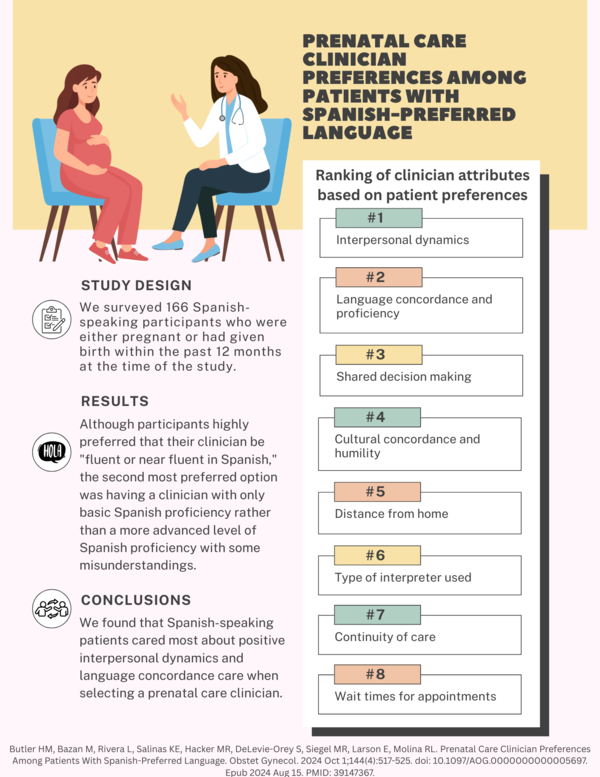
OBJECTIVE: To measure what patients with Spanish language preference and limited English proficiency value most when selecting a prenatal care clinician.

METHODS: A discrete choice experiment was administered at two large academic medical centers in Boston, Massachusetts. Participants were identified by electronic medical record, had preferred Spanish language and self-identified limited English proficiency, and either were pregnant with a completed fetal anatomy scan or had given birth within the past 12 months at the time of the study. The discrete choice experiment consisted of eight attributes to consider when selecting a prenatal care clinician: clinician Spanish proficiency, type of interpreter used, interpersonal dynamics (ie, making patients feel seen, heard, and cared for), cultural concordance, continuity of care, shared decision making, distance from home, and wait times for appointments. Descriptive statistics of demographic variables were calculated. Hierarchical Bayesian models were used to analyze discrete choice experiment data.

RESULTS: The attributes that were most important to 166 participants when choosing their prenatal care clinician were interpersonal dynamics within the patient-clinician dyad and clinician Spanish language proficiency (average importance 21.4/100 and 20.8/100, respectively). Of lowest importance were wait time to receive an appointment and continuity of care (average importance 5.1 and 6.1, respectively). Although participants highly preferred that their clinician be "fluent or near fluent in Spanish," the second most preferred option was having a clinician with only basic Spanish proficiency rather than a more advanced level of Spanish proficiency with some misunderstandings.

CONCLUSION: Our study demonstrates the importance of positive clinician-patient interpersonal dynamics and language-concordant care for patients with Spanish language preference in prenatal care. Promoting equitable patient-centered care for patients with limited English proficiency requires responding to preferences regarding clinician language proficiency and demonstrating attentiveness, empathy, and concern for prenatal care experiences.

Binda DD, Harris AC, Tan T, Fischer K, Molina RL, Mehta D. Examining the Role of Medical School Faculty in Developing Students’ Cultural Humility Skills: Insights From a Single-Center Multimethod Study.. Global advances in integrative medicine and health. 2024;13:27536130241305087. doi:10.1177/27536130241305087

BACKGROUND: While the Liaison Committee on Medical Education emphasizes the teaching of cultural competence in medical education, the concept of cultural humility, focusing on self-reflection and lifelong learning, has been proposed as a more effective approach. Although there have been numerous discussions on both topics, understanding how faculty in clinical settings help students develop cultural humility skills remains limited.

OBJECTIVE: Our multimethod study utilized a survey and semi-structured interviews to identify strategies that faculty at one institution use to help students develop cultural humility skills.

METHODS: We administered a 10-question survey to assess faculty demographics, teaching characteristics, and familiarity with cultural humility. Participants most familiar with cultural humility were invited for semi-structured interviews. Survey data were analyzed with descriptive statistics, and interview data were thematically analyzed to identify key teaching strategies.

RESULTS: In our study of 49 medical faculty members, the majority of participants were female (61%) and predominantly White (67%), covering a wide range of specialties and years of teaching. Of the participants, 74% expressed being at least somewhat familiar with cultural humility, and 10 consented to interviews. Strategies for cultural humility education included one-on-one instruction, feedback, and reflections. Thematic analysis underscored fostering learner curiosity about cultures, early patient exposure, and incorporating diverse learning perspectives as essential in developing students' cultural humility skills.

CONCLUSION: Cultural humility is an important attribute for healthcare professionals that can enhance patient-centered care. Through focused interviews with faculty in our study and subsequent thematic analysis, our results suggest the need for longitudinal and multimodal educational strategies to cultivate cultural humility among medical students. By understanding current teaching methods, educators can design and assess more effective curricula to prepare future doctors for a culturally diverse patient population.