
Ex-vivo Biomechanics:
Upper extremity injuries, specifically those relating the shoulder, are one of the most commonly seen musculoskeletal injuries seen by clinicians. To that end, MTII has developed a novel robotic testing system used to evaluate shoulder biomechanics. This system can passively abduct the shoulder joint measuring forces, moments, pressures, and coordinates of the shoulder during testing. Our motion capture camera system allows for motion capture for analysis of the soft tissues surrounding the shoulder joint, coupled with digital image correlation we are able to assess the strain during passive motion. MTII has performed numerous studies looking at the impact of rotator cuff injuries and the effect on the shoulder’s biomechanical abilities.
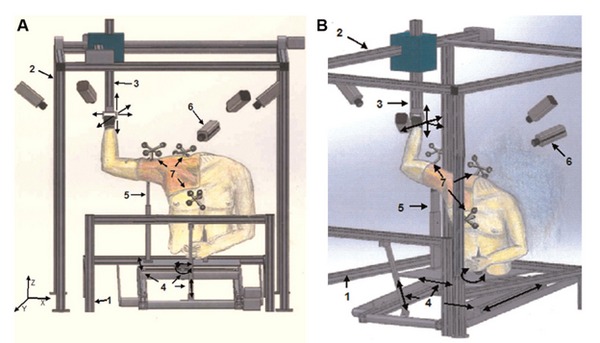
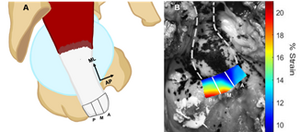
Current Projects: Progression and propagation of partial thickness to full thickness rotator cuff tears.
Selected Publications:
1. Entezari V, Trechsel BL, Dow WA, Stanton SK, Rosso C, Müller A, McKenzie B, Vartanians V, Cereatti A, Della Croce U, Deangelis JP, Ramappa AJ, Nazarian A. Design and manufacture of a novel system to simulate the biomechanics of basic and pitching shoulder motion. Bone Joint Res. 2012 May 1;1(5):78-85.
2. Mueller AM, Rosso C, Entezari V, McKenzie B, Hasebroock A, Cereatti A, Della Croce U, Nazarian A, Ramappa AJ, DeAngelis JP. The effect of supraspinatus tears on glenohumeral translations in passive pitching motion. Am J Sports Med. 2014 Oct;42(10):2455-62.
3. Haghpanah B, Walley KC, Hingsammer A, Harlow ER, Oftadeh R, Vaziri A, Ramappa AJ, DeAngelis JP, Nazarian A. The effect of the rotator interval on glenohumeral kinematics during abduction. BMC Musculoskelet Disord. 2016 Jan 28;17:46.
4. Walley KC, Haghpanah B, Hingsammer A, Harlow ER, Vaziri A, DeAngelis JP, Nazarian A, Ramappa AJ. Influence of disruption of the acromioclavicular and coracoclavicular ligaments on glenohumeral motion: a kinematic evaluation. BMC Musculoskelet Disord. 2016 Nov 17;17(1):480.
5. Garica M, Caro D, Buzo, M, Stewart I, Rodriguez DV, King E, Momenzadeh K, Abbasian M, Kheir N, Ramappa AJ, Nazarian A, (2022). Analysis of Supraspinatus Tendon Subregions and the Relation to Rotator Cuff Tears: A Cadaveric Study. (IN REVIEW)
In-silico Biomechanics:
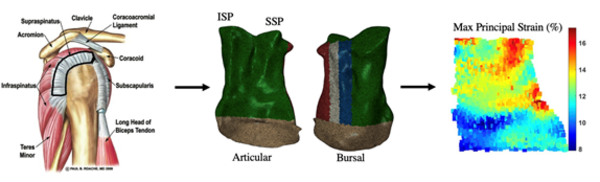
Finite Element Modeling (FEM) allows for the investigation of biomechanical systems that can be difficult to be measure in-vivo and allows for a cheaper and faster method than ex-vivo testing. We are skilled in creating high fidelity – patient specific computational models of and soft tissues. These models are useful in studying the effects of patient specific parameters such as age, material properties, and morphology on diseases in the musculoskeletal system to better inform clinical decisions.
Current Projects: Patient specific rotator cuff tear predictions using Finite Element Modeling.
1. Williamson, P., Garcia, M., Momenzadeh, K. et al. A Validated Three-Dimensional, Heterogenous Finite Element Model of the Rotator Cuff and The Effects of Collagen Orientation. Ann Biomed Eng (2022). https://doi.org/10.1007/s10439-022-03114-9
In-vivo Mechanobiology:
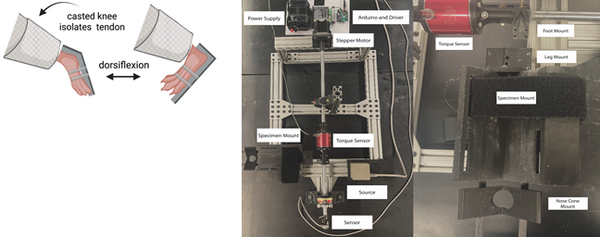
Tendinopathy and tendon ruptures are one of the most common musculoskeletal injuries seen in the public and sports, alike. MTII has developed a testing system that applies in vivo cyclic loading to the rat Achilles tendon and enables the noninvasive assessment of the structural, biological, and mechanical responses of the rat Achilles tendon to in vivo mechanical stimuli. In vivo rat studies performed with this system can provide an avenue to better understanding tendon overuse injuries, such as tendon rupture and tendinopathy, as well as characterizing mechanical responses of the tendon under varying degrees of overuse and healing timepoints.
Current Projects: Assessment of the changes in mechanical, biological, and structural markers due to fatigue loading in a rat Achilles tendon model