
Targeting eicosanoids and pro-resolving lipid mediators to prevent cancer cachexia and chemical carcinogenesis
Cachexia and environmentally-driven carcinogenesis are both fueled by chronic, unresolved inflammation and a dysregulated eicosanoid storm. Our lab uses debris-stimulated cancer models and preclinical inflammation-driven systems to define how specialized pro-resolving lipid mediators (SPMs) — including resolvins, maresins, and protectins — counter-regulate this pro-inflammatory state without immunosuppression. We also study how perioperative inflammation blockade and resolution stimulation can prevent metastatic recurrence. This work is supported by two NIH R01 grants from the NCI focused on inflammation resolution in cachexia and chemical carcinogenesis.
Fishbein A, Hammock BD, Serhan CN, Panigrahy D. Carcinogenesis: Failure of Resolution of Inflammation? Pharmacol Ther. 2021;218:107670.
Sulciner ML, Serhan CN, Gilligan MM, et al. Resolvins Suppress Tumor Growth and Enhance Cancer Therapy. J Exp Med. 2018;215(1):115-140.
Chang J, Bhasin SS, Bielenberg DR, et al. Chemotherapy-Generated Cell Debris Stimulates Colon Carcinoma Tumor Growth via Osteopontin. FASEB J. 2019;33(1):114-125.
Haak VM, Huang S, Panigrahy D. Debris-Stimulated Tumor Growth: A Pandora's Box? Cancer Metastasis Rev. 2021;40(3):791-801.
Panigrahy D, Gartung A, Yang J, et al. Preoperative Stimulation of Resolution and Inflammation Blockade Eradicates Micrometastases. J Clin Invest. 2019;129(7):2964-2979.
Gilligan MM, Gartung A, Sulciner ML, et al. Aspirin-Triggered Proresolving Mediators Stimulate Resolution in Cancer. Proc Natl Acad Sci USA. 2019;116(13):6292-6297.
Greene ER, Huang S, Serhan CN, Panigrahy D. Regulation of Inflammation in Cancer by Eicosanoids. Prostaglandins Other Lipid Mediat. 2011;96(1-4):27-36.
Sulciner ML, Gartung A, Gilligan MM, Serhan CN, Panigrahy D. Targeting Lipid Mediators in Cancer Biology. Cancer Metastasis Rev. 2018;37(2-3):557-572.
Desmedt C, Demicheli R, Fornili M, et al. Potential Benefit of Intra-Operative Administration of Ketorolac on Breast Cancer Recurrence According to the Patient's Body Mass Index. J Natl Cancer Inst. 2018;110(10):1115-1122.
Retsky M, Rogers R, Demicheli R, et al. NSAID Analgesic Ketorolac Used Perioperatively May Suppress Early Breast Cancer Relapse: Particular Relevance to Triple Negative Subgroup. Breast Cancer Res Treat. 2012;134(2):881-888.
Luyckx M, Verougstraete C, Jouret M, et al. Intraoperative Ketorolac and Outcomes After Ovarian Cancer Surgery. J Clin Med. 2024;13(6):1546.
Forget P, Machiels JP, Coulie PG, et al. Neutrophil:Lymphocyte Ratio and Intraoperative Use of Ketorolac or Diclofenac Are Prognostic Factors in Different Cohorts of Patients Undergoing Breast, Lung, and Kidney Cancer Surgery. Ann Surg Oncol. 2013;20(Suppl 3):S650-S660.
Stimulating the resolution of inflammation to prevent pediatric brain cancer
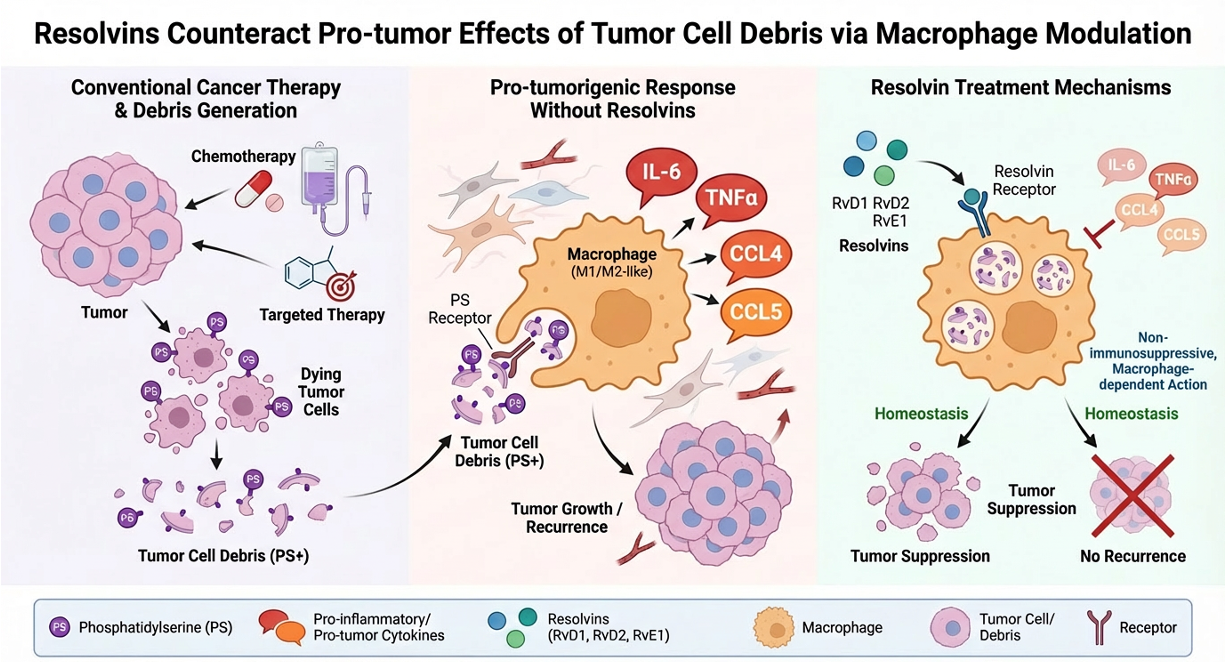
Conventional cancer therapies generate cellular debris that paradoxically stimulates tumor growth and dormancy escape through a macrophage-derived cytokine storm. Building on our medulloblastoma and debris-stimulation work, we investigate how SPMs promote phagocytic clearance of tumor debris, reprogram the tumor microenvironment, and suppress the inflammatory signaling that drives pediatric brain tumor progression and angiogenesis. The goal is to identify non-toxic, resolution-based strategies that complement standard pediatric oncology care.
Sulciner ML, Serhan CN, Gilligan MM, et al. Resolvins Suppress Tumor Growth and Enhance Cancer Therapy. J Exp Med. 2018;215(1):115-140.
Kelly AG, Panigrahy D. Targeting Angiogenesis via Resolution of Inflammation. Cold Spring Harb Perspect Med. 2023;13(3):a041172.
Panigrahy D, Gilligan MM, Serhan CN, Kashfi K. Resolution of Inflammation: An Organizing Principle in Biology and Medicine. Pharmacol Ther. 2021;227:107879.
Targeting precision nutrition to prevent chronic inflammation in cancer and other inflammation-associated diseases such as cystic fibrosis
Dietary lipid precursors shape the endogenous pools available for eicosanoid and SPM biosynthesis, directly influencing whether inflammation resolves or becomes chronic. In collaboration with Prof. Steven Freedman (Director, Pancreas Institute, BIDMC; Harvard Medical School), the lab investigates how precision-nutrition approaches can restore resolution programs in cystic fibrosis and other chronic inflammatory conditions, complementing our broader work on inflammation-driven cancer risk. The long-term aim is rationally designed nutritional interventions that augment the body's own healing programs.
Quinlivan KM, Howard IV, Southan F, et al. Exploring the Unique Role of Specialized Pro-Resolving Mediators in Cancer Therapeutics. Prostaglandins Other Lipid Mediat. 2025;178:106944.
Panigrahy D, Gilligan MM, Serhan CN, Kashfi K. Resolution of Inflammation: An Organizing Principle in Biology and Medicine. Pharmacol Ther. 2021;227:107879.
Targeting soluble epoxide hydrolase to prevent inflammation-associated cancers
Soluble epoxide hydrolase (sEH) degrades epoxy-fatty acids that actively resolve inflammation; pharmacologic sEH inhibition stabilizes these mediators and restores homeostatic signaling. Through long-standing collaborations with Prof. Bruce Hammock (UC Davis, in memoriam) and Dr. Darryl Zeldin (NIH-NIEHS), our lab investigates sEH as a therapeutic target to interrupt the chronic inflammatory signaling that drives cancer initiation and progression, positioning sEH inhibition as a complementary, non-immunosuppressive strategy to conventional cancer therapy.
Fishbein A, Hammock BD, Serhan CN, Panigrahy D. Carcinogenesis: Failure of Resolution of Inflammation? Pharmacol Ther. 2021;218:107670.