
Fellow Spotlight: Azariah Boyd
Apply for the 2027-2028 Zimetbaum Fellowship. Applications due October 1st.
July 21, 2025
Azariah Boyd, MS is the 2024-2025 Joan and Marcel Zimetbaum Research Fellow at the Smith
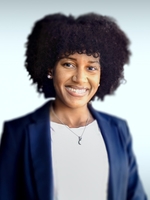
Center for Outcomes Research, working under the mentorship of Dr. Wadhera. She holds an MS in Environmental Health Epidemiology from the Harvard T.H. Chan School of Public Health and a Donald Hopkins Predoctoral Scholar, where she developed a passion for using research methods to understand socio-environmental exposures and health outcomes that directly inform health policy. This year, she focused on direct health policy research, with a particular focus on reproductive health policy and safety-net programs.
Why health policy research? How has the Smith Center helped shape your journey in medicine/research?
My path to health policy research was shaped by witnessing firsthand how systemic inequities shaped health in my own community and through experiences working with my community. From conducting environmental justice research in Boston to providing bilingual care management for Spanish-speaking families, I realized that while individual interventions are important, lasting change requires understanding and improving the policies that shape population health.
The Smith Center has been transformative in helping me develop hands-on analytical and methodological rigor needed to answer complex policy and public health questions. Being selected for this highly competitive fellowship has allowed me to have invaluable mentorship to learn from physician-leaders and broaden my perspective on how to move research beyond good intentions and measure actual change.
What’s one project that you’re proud of?
I am very proud of my research on how the Dobbs decision has affected women’s mental health across income levels. This project feels personal because I’ve watched women in my community navigate impossible choices around reproductive health, often determined by what they could afford rather than what they needed. We were able to quantify something we’ve always known – that policy changes don’t affect everyone equally. Women with fewer resources bear the brunt of restrictive policies. This research has the potential to inform future reproductive health policies with hard data about the mental health consequences of limiting access for socioeconomically disadvantaged women.
What are some of the most important lessons you’ve learned during your time at the Smith Center?
Three things stand out: First, good research design matters more than fancy analysis—you can't statistically model your way out of a poorly designed study. Second, interdisciplinary collaboration is everything. Working with biostatisticians, clinicians, and policy experts has shown me that the most impactful research happens when different perspectives come together. Finally, I've learned that rigorous methodology means nothing if you can't communicate your findings. Growing up in spaces where people spoke directly and honestly, I've had to learn how to translate that clarity into academic and policy settings while maintaining the urgency of the issues we're studying.
What’s next for you?
My ultimate goal is medical school—I want to become a physician who can address health disparities at both the individual patient level and the systems level. This fellowship has been incredible preparation for that journey, giving me the research foundation to understand how policies shape health outcomes before patients even walk into a clinic. In the short term, I'm working on manuscripts examining food security interventions and reproductive health policy impacts—research that will inform my future practice and advocacy as a physician. I'm applying to medical school with the goal of eventually becoming a physician-scientist who can bridge clinical care with policy research. Long-term, I envision practicing in underserved communities while continuing to conduct research that informs both clinical practice and health policy. I want to be the kind of doctor who can not only treat patients but also understand and address the structural barriers that brought them to my office in the first place.
What’s your favorite Smith Center memory?
My favorite Smith Center memories are definitely the conferences we've traveled to—some of the largest conferences in the country. Being able to present research and see our work reach audiences beyond academia has been incredible. There's something powerful about standing in those spaces, representing not just the Smith Center but the communities our research serves, and knowing that our findings could actually influence policy decisions.
Watch Azzie discuss her time as a Zimetbaum Fellow here.
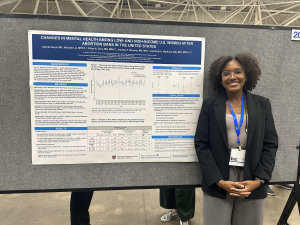
Azariah presenting her work on changes in women's mental health after abortion bans in the US at the AcademyHealth Annual Research Meeting 2025, the largest health policy conference in the nation.

