

Research
Core Services
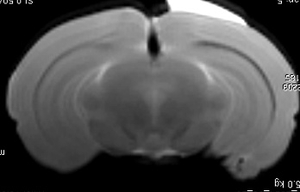
The Preclinical MRI Core at Beth Israel Deaconess Medical Center provides state-of-the-art imaging services, including:
- in vivo imaging of small animal models including mice, rats, and certain amphibians
- high-resolution imaging of patient tissue samples
- hyperpolarized carbon-13 for imaging of perfusion and metabolism
- our imaging platform supports arterial spin-labeling, diffusion-weighted and diffusion-tensor imaging, and multinuclear spectroscopy
- the Core provides full service imaging including protocol design, image acquisition, and support for data analysis
Hyperpolarized Carbon-13
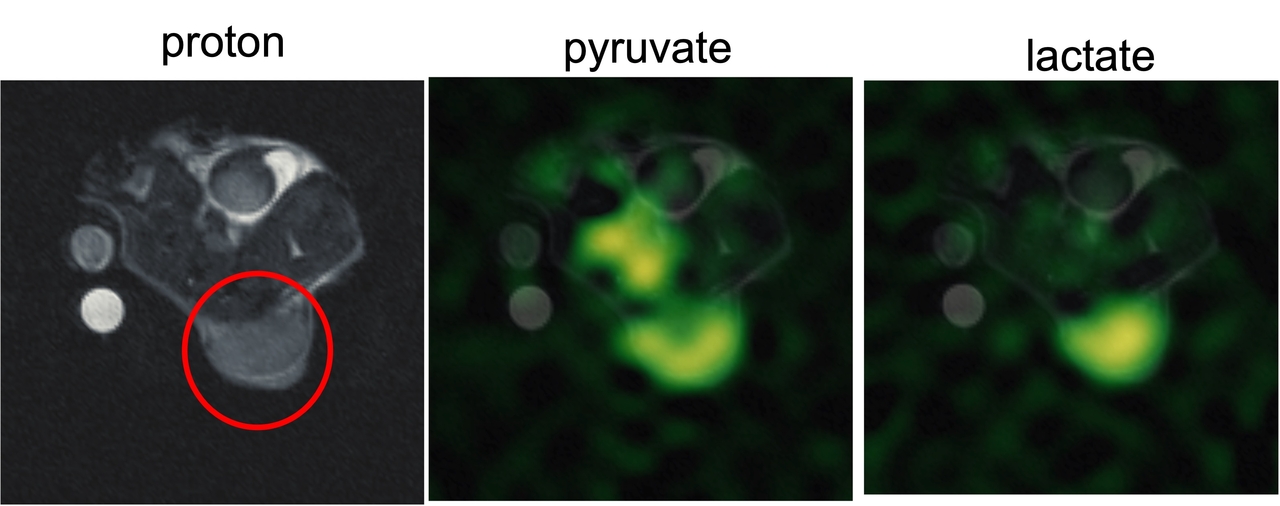
Hyperpolarization is a technology that enhances the signal from tracer molecules by a factor of 10,000-100,000. This makes it possible to image the transport, uptake, and metabolism of dilute tracer molecular and metabolites with MRI. Pyruvate (seen in images above) is a common metabolic probe used to assess rates of glycolytic fermentation in cancer through its conversion to lactate. In the images above, a tumor-bearing mouse (left) shows high levels of pyruvate signal (center) in the large vessels, while high rates of lactate formation are seen within the tumor (right).
Hyperpolarized imaging is available as a Core service in mice and rats.
Hyperpolarization Resources
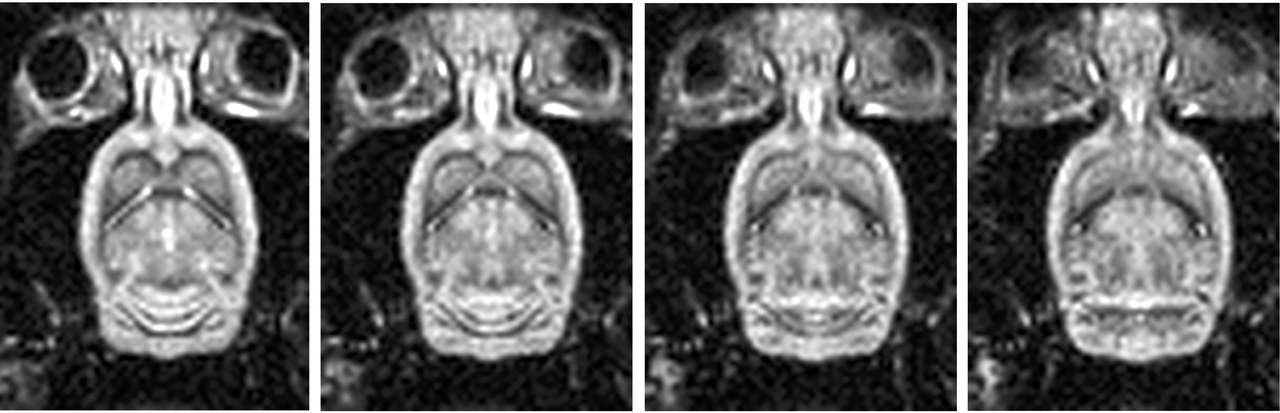
Hyperpolarized tertiary-butyl alcohol is a perfusion tracer developed in our lab.
Resources for polarizing and imaging t-butanol can be found here.

