

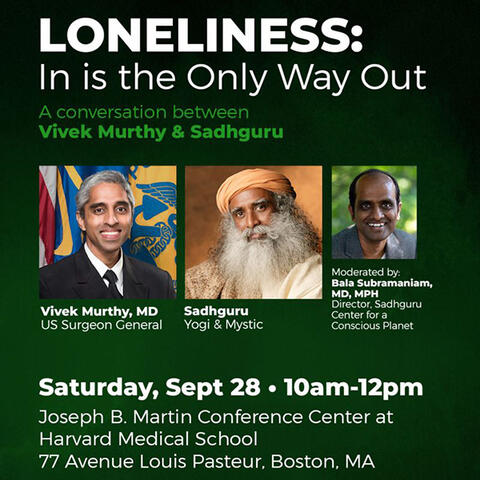
The US Surgeon General Vivek Murthy, MD, MBA and spiritual leader Sadhguru had a remarkable conversation about a growing and serious problem in our society, “Loneliness: In is the only way out.” The September 28 session, moderated by Dr. Bala Subramaniam, was held at the Joseph B. Martin Conference center at HMS with 500 attendees.. Dr. Murthy’s work as a doctor and health leader led him to realize that loneliness and social isolation contribute not only to unhappiness but have damaging impacts on physical health. Sadhguru brings his deep inner wisdom and unique insight to this topic, stressing that the neglect of the inner life contributes not only to loneliness, but psychological and societal problems. We include excerpts from this wide-ranging talk below and a link to view the entire conversation, already viewed by over 217,000 people! To hear the entire conversation, click here.
Vivek Murthy: I had a loving family but struggled sometimes as a shy and introverted kid with loneliness and isolation. Later as a doctor, many patients had infections or other diagnoses, but also struggled with loneliness and isolation. When I became Surgeon General I saw that many people across our country struggle with these same feelings and it led me to examine the impact of loneliness and the science behind it. At the height of the pandemic, 50% of US adults were struggling with loneliness; over 50% of young people report experiencing loneliness. This disconnection increases risk of depression, anxiety and physical illness - 29% increased risk of heart disease, 31% for stroke, and 50% for dementia among older people as well as higher risk of premature death. This is a huge health issue comparable to the impact of smoking and obesity. We have roles and individual directions, but at times need support from one another. In order to be deeply connected to others, one also needs to be connected to oneself, to understanding your worth, value, and connection to the universe; but sometimes we need other people to help us on this path - they can be like mirrors to help us see ourselves more clearly the way good friends and family do.
Sadhguru: Loneliness is not a social phenomenon; it is a psychological phenomenon produced in the society structure. You can be lonely in a crowd or with people you love. The value of solitude is gone in our society. Solitude is a profound time when you imbibe life. Time spent imbibing and perceiving and time spent in expression should be balanced. If you spend two thirds of your time imbibing and one third expressing, the one third of your time expressing will be more profound. It will be of value, not just noise in the world. Now there are many opportunities to express, often on social media, even for children. Children are missing the opportunity to take life in. Loneliness is a natural consequence of this. Loneliness is an incubating factor for mental illness. If you do not adjust the progress of technology, the problem will increase the number of people who are mentally troubled. If we don’t intervene for the human species the conveniences of technology will go to waste because people will not be psychologically healthy.
Vivek Murthy: Build simple things into your day to strengthen your sense of connection. Find a few minutes to sit and just breathe, maybe on your doorstep seeing nature or at night when everyone has gone to bed. Life is so focused on doing, that we often don’t focus on being. Take five minutes a day to reach out to someone you care about – maybe a relative or a friend - just to check on them. If you can, do one kind thing each day. It can be very simple. If someone walking down the hall drops their papers, stop for a moment and help pick them up. Or if someone seems down or sad, take a moment to ask them if they are okay. Be wholly present while doing these things. It may take just a few minutes a day but can help establish the basis for peace and compassion in our lives.
Sadhguru: Human beings want well-being to come to them-they don’t want to create it. Loneliness is not about people--people are a bit of an antidote. Loneliness is of time and time is always rolling. We don’t have to spend it - you sit here it goes away. If time feels burdensome, it rolls too slow. Loneliness is happening because there is nothing behind your thought and emotional process. Freedom is a consequence of living in a certain way, not something you can aspire to. You cannot create the consequence, but can only nurture the plan. The root must happen and you must have patience and nurture it because otherwise the fruit will not come. But now we are plucking the fruit out of a non-existent tree. Today life is about doing and dominance, not about being. People think being just being means being useless, but only a rooted plant will flower and produce fruit.
Vivek Murthy: Technology is changing how we relate to each other, so we need to decide how to utilize it in our lives. We may be around people and digitally connected, but often the ability to lean on someone who knows us and give compassion and affection is missing, and this is something we need. Young people tell me it is no longer comfortable to approach people because they are always on devices and it feels like they are interrupting. When that is what you’ve known from an early age it is hard to learn social skills like conversation and comparing points of view. That doesn’t come naturally – it has to be cultivated. I worry that the ability to be reflective and contemplative has disappeared. Now with phones, the time waiting for the bus or to meet someone is filled with the screen and we don’t have unplanned interactions and moments for reflection.
Sadhguru: People text when they are walking and you have to make way or they will bump into you. Everything else in the world is missing except the phone screen. This means you have heaps of information, no experience and a false sense of knowing everything. If something happens you are like a deer in the headlights because you are somewhere else and suddenly something happens here. This is a dangerous way to cultivate a society. What we do in schools and homes is also important. Parents often struggle with the same issues they have always struggled with. Children don’t listen to what you say; you need to be a good example. If you aren’t, they will go many steps ahead of that. It is important to create a good atmosphere because a child is not just a reproduction but the next generation.

