Tell us about yourself and what you do.
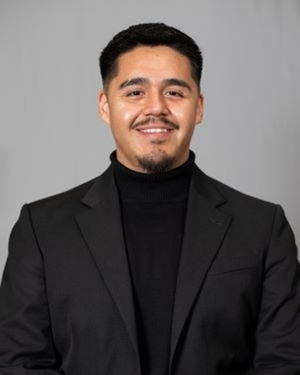
My name is Marcos "Gomez" Ambriz, and I am a fourth-year medical student at the Lewis Katz School of Medicine at Temple University and proud Co-Director for the Latino Medical Student Association Northeast region. It has been an honor to spend the last year at the Richard A. and Susan F. Smith Center for Outcomes Research at Beth Israel Deaconess Medical Center. Thanks to the generous support of the Joan and Marcel Zimetbaum Research Fellowship and the mentorship of Dr. Rishi Wadhera, I have come closer to realizing my goal of becoming an academic surgeon in health policy and outcomes research.
Outside of medicine, you will usually find me working out, at a show listening to electronic music, a few miles into a long run, or hanging out with my dog (Joy).
Why medicine? How has the Smith Center played a role in your journey to become a doctor?
My story begins on a small pig farm in Mexico, where my mother was born and raised. At 21, pregnant with my older brother, she crossed the Sonoran Desert in search of a different future, eventually settling in Arizona, where she gave birth to my brother and, a year later, to me. My mother has worked at McDonald's for the past 25 years, doing everything in her power to shield us from the realities of growing up in a single-parent, low-income, uninsured immigrant household. We relied on food banks, free clinics, and public transportation to get by. It wasn't until late in high school that I found my academic spark, and not until college that a passion for science overtook my early plan to become an immigration lawyer.
Going into medical school, service and advocacy were my guiding values, but I always felt a pull to create impact beyond my local community. The Zimetbaum Fellowship bridged that gap. I learned how health policy research can address issues of access, equity, and outcomes, working on studies examining immigration policy's impact on Latino community health, evaluating the No Surprises Act's impact on medical debt, and now pivoting toward transplant surgery research, the field I'm pursuing. My mother's story has always been my "why" in medicine, and this fellowship gave me the clarity and voice to connect that lived experience to my goal of becoming an academic transplant surgeon working to improve the US transplant system.
What’s one high impact project you worked on/ a project that you’re proud of?
The project I keep coming back to is the Lancet paper on anti-immigration measures and health. This was my first real hands-on introduction to difference-in-differences design. Learning a rigorous causal method while working on a topic that hits close to home made the method stick in a way that simply reading about it never could. Lastly, learning from Michael Liu, MD, MPhil, allowed me to see a different thought process and writing style from mine.
What are some of the most important things you’ve learned during your time at the Smith Center?
The most important thing I learned at the Smith Center was how much the prep work matters. The No Surprises Act study was my first project as first author. I thought I had a clean and thorough statistical action plan going into the analysis phase. We hit many wrinkles, findings we did not expect, and we ended up reworking pieces of the plan more than once. The lesson I took from this was that you cannot out-plan every surprise. But with better preparation and strong communication, you can build a team that handles surprises well.
What’s next for you and how do you plan to take what you learned at the Smith Center and apply it to future endeavors?
Next up is matching into general surgery, hopefully into a program where I can keep building toward academic transplant surgery. I'm not planning to leave the outcomes research behind once I am in scrubs. The causal inference training I got this year changed how I look at research. A few of the papers from this year are still working their way through review, and I plan to stay on them until they are published.
Favorite Smith Center memory/your favorite thing about the Smith Center.
My favorite thing about the Smith Center is the "Pit," where all the fellows sit. Not one single moment, just the atmosphere of the place. You can walk over or turn around to anyone and ask them to workshop an idea, talk through strategy and methods, or just talk about life. It felt like everyone was rooting for one another's success. I do not think I fully appreciated how rare it was until I was in the middle of it.
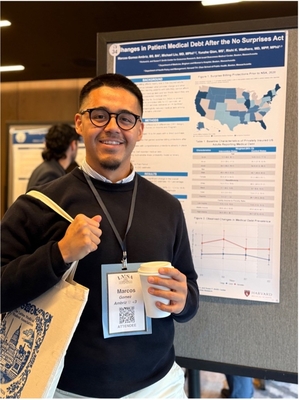
Gomez presents his work from his time at the Smith Center while at LMSA 2026

