
There is growing evidence that language discordance between patients and their health care teams negatively affects quality of care, experience of care, and health outcomes, yet there is limited guidance on best practices for advancing equitable care for patients who have language barriers within obstetrics and gynecology. In this commentary, we present two cases of language-discordant care and a framework for addressing language as a critical lens for health inequities in obstetrics and gynecology, which includes a variety of clinical settings such as labor and delivery, perioperative care, outpatient clinics, and inpatient services, as well as sensitivity around reproductive health topics. The proposed framework explores drivers of language-related inequities at the clinician, health system, and societal level. We end with actionable recommendations for enhancing equitable care for patients experiencing language barriers. Because language and communication barriers undergird other structural drivers of inequities in reproductive health outcomes, we urge obstetrician-gynecologists to prioritize improving care for patients experiencing language barriers.
Language Access
BACKGROUND: Qualified language service providers (QLSPs)-professional interpreters or multilingual clinicians certified to provide care in another language-are critical to ensuring meaningful language access for patients. Designing patient-centered systems for language access could improve quality of pregnancy care.
OBJECTIVE: We synthesized and identified gaps in knowledge about communication preferences during pregnancy care among patients with Spanish primary language.
METHODS: We performed a scoping review of original research studies published between 2000 and 2022 that assessed communication preferences in Spanish-speaking populations during pregnancy care. Studies underwent title, abstract, and full-text review by three investigators. Data were extracted for synthesis and thematic analysis.
RESULTS: We retrieved 1,539 studies. After title/abstract screening, 36 studies underwent full-text review, and 13 of them met inclusion criteria. Two additional studies were included after reference tracing. This yielded a total of 15 studies comprising qualitative (n = 7), quantitative (n = 4), and mixed-methods (n = 4) studies. Three communication preference themes were identified: language access through QLSPs (n = 7); interpersonal dynamics and perceptions of quality of care (n = 9); and information provision and shared decision-making (n = 8). Although seven studies reported a strong patient preference to receive prenatal care from Spanish-speaking clinicians, none of the included studies assessed clinician Spanish language proficiency or QLSP categorization.
CONCLUSIONS: Few studies have assessed communication preferences during pregnancy care among patients with primary Spanish language. Future studies to improve communication during pregnancy care for patients with primary Spanish language require intentional analysis of their communication preferences, including precision regarding language proficiency among clinicians.
OBJECTIVE: To explore Spanish-speaking patients' experiences and preferences regarding communication during pregnancy care with specific attention to language barriers.
METHODS: Patients with a Spanish language preference who gave birth between July 2022 and February 2023 at an academic medical center were invited to participate in focus groups. Focus groups were held over Zoom, audio-recorded, transcribed in Spanish, translated into English, and reviewed for translation accuracy. Thematic analysis was conducted with deductive and inductive approaches. Three investigators double-coded all transcripts, and discrepancies were resolved through team consensus.
RESULTS: Seven focus groups (27 total participants, range 2-6 per group) were held. Three key themes emerged regarding patient experiences and communication preferences when seeking pregnancy care: 1) language concordance and discordance between patients and clinicians are not binary-they exist on a continuum; 2) language-discordant care is common and presents communication challenges, even with qualified interpreters present; and 3) language discordance can be overcome with positive interpersonal dynamics between clinicians and patients.
CONCLUSION: Our findings highlight the importance of relationship to overcome language discordance among patients with limited English proficiency during pregnancy care. These findings inform potential structural change and patient-clinician dyad interventions to better meet the communication needs of patients with limited English proficiency.
OBJECTIVE: To measure what patients with Spanish language preference and limited English proficiency value most when selecting a prenatal care clinician.
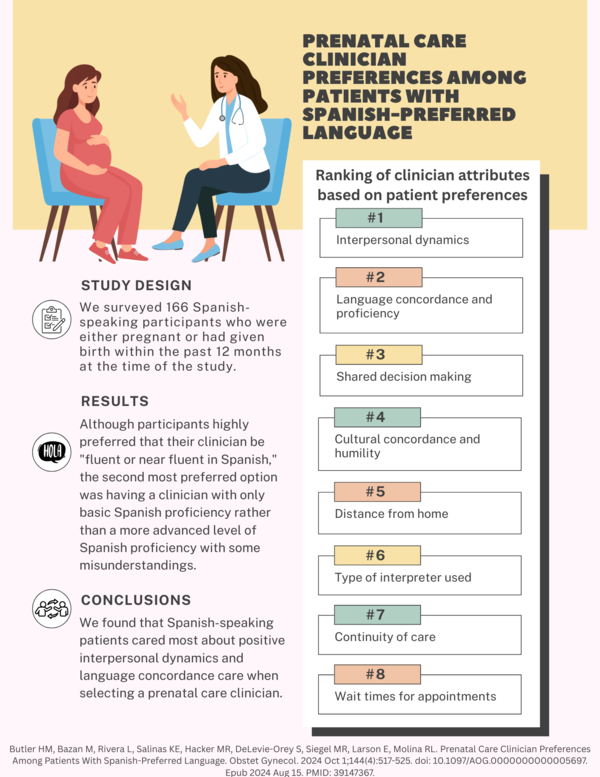
METHODS: A discrete choice experiment was administered at two large academic medical centers in Boston, Massachusetts. Participants were identified by electronic medical record, had preferred Spanish language and self-identified limited English proficiency, and either were pregnant with a completed fetal anatomy scan or had given birth within the past 12 months at the time of the study. The discrete choice experiment consisted of eight attributes to consider when selecting a prenatal care clinician: clinician Spanish proficiency, type of interpreter used, interpersonal dynamics (ie, making patients feel seen, heard, and cared for), cultural concordance, continuity of care, shared decision making, distance from home, and wait times for appointments. Descriptive statistics of demographic variables were calculated. Hierarchical Bayesian models were used to analyze discrete choice experiment data.
RESULTS: The attributes that were most important to 166 participants when choosing their prenatal care clinician were interpersonal dynamics within the patient-clinician dyad and clinician Spanish language proficiency (average importance 21.4/100 and 20.8/100, respectively). Of lowest importance were wait time to receive an appointment and continuity of care (average importance 5.1 and 6.1, respectively). Although participants highly preferred that their clinician be "fluent or near fluent in Spanish," the second most preferred option was having a clinician with only basic Spanish proficiency rather than a more advanced level of Spanish proficiency with some misunderstandings.
CONCLUSION: Our study demonstrates the importance of positive clinician-patient interpersonal dynamics and language-concordant care for patients with Spanish language preference in prenatal care. Promoting equitable patient-centered care for patients with limited English proficiency requires responding to preferences regarding clinician language proficiency and demonstrating attentiveness, empathy, and concern for prenatal care experiences.
BACKGROUND: Engaging patients in quality improvement and innovation projects is increasingly important, yet challenges persist with involving patients who speak languages other than English. This article presents design activities our team used to engage Spanish-speaking patients and cultural brokers.
OBJECTIVE: To develop a clinician communication tool to enhance patient trust in pregnancy care clinicians, especially among minoritized populations who face language and cultural barriers, using human-centered design (HCD).
PATIENT INVOLVEMENT AND INNOVATION: We centered end-user experiences, including clinicians, Spanish-speaking patients, and Spanish-speaking cultural brokers, in our design process through multiple feedback sessions and modalities.
METHODS: We used a HCD process to understand the problem, co-design a tool, and prepare for testing of a clinician tool. Design activities included a critical literature review, user interviews, design principles, solution sketching, rapid cycle feedback with subject matter experts, and field experience with pregnancy clinicians.
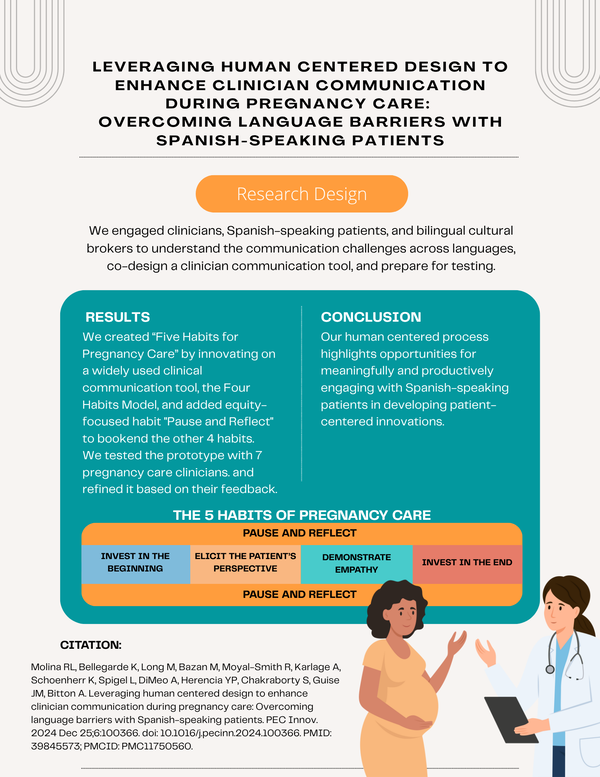
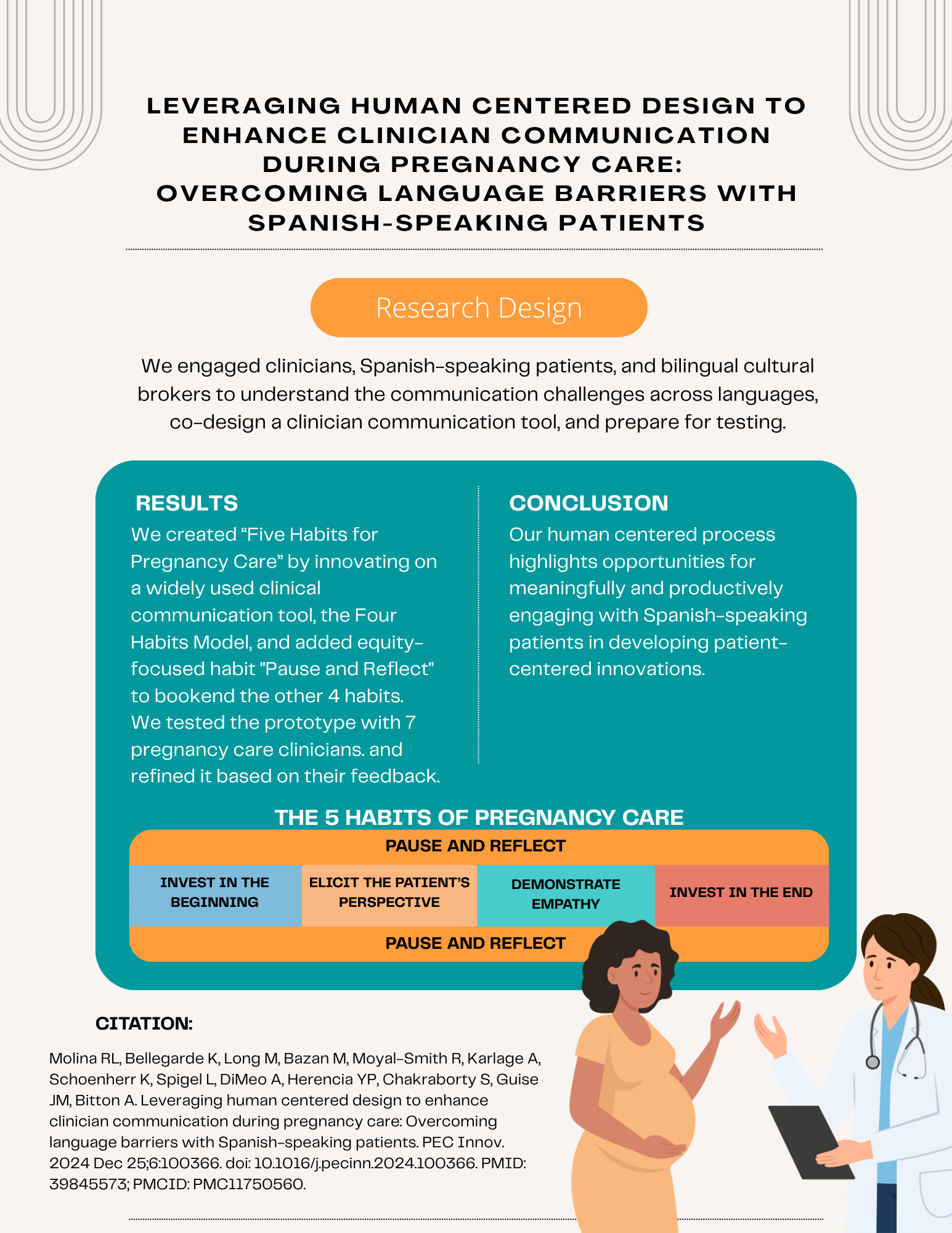
RESULTS: We innovated on a widely used clinical communication tool, the Four Habits Model, and developed the Five Habits for Pregnancy Care to support pregnancy care clinicians in building trust by bridging cultural and language differences. We added an equity-focused habit "Pause and Reflect" to bookend the Four Habits. We refined the tool to meet different needs across pregnancy care visits based on feedback from 7 clinicians.
DISCUSSION: We applied equity principles in a HCD process to understand a problem, co-design a tool, and prepare for testing by engaging with patients and cultural brokers in Spanish. Balancing the differing approaches for designers and researchers yielded important insights for enhancing equitable processes and outcomes in healthcare improvement.
PRACTICAL VALUE: Communication tools designed with and for minoritized populations are critical for improving trust in all patient-clinician dyads during pregnancy care.