Publications

2026

Gama ZAS, Saraiva COP de O, Rosendo TMS de S, et al. Association between patient safety culture, adverse events, and essential practices during childbirth in six Brazilian maternity hospitals.. International journal of gynaecology and obstetrics: the official organ of the International Federation of Gynaecology and Obstetrics. Published online 2026. doi:10.1002/ijgo.70890

OBJECTIVE: This study examines whether hospitals with stronger patient safety culture more consistently follow essential birth practices and have fewer adverse outcomes for mothers and newborns and whether this evidence can guide maternity care priorities in patient safety policy.

METHODS: We conducted a multicenter cross-sectional study in six public maternity hospitals in Brazil (November 2022 to February 2024). In each hospital, we measured patient safety culture using the Brazilian version of the Hospital Survey on Patient Safety Culture. From a systematic sample of 2183 births (approximately 360 per hospital), we reviewed charts to record eight essential obstetric and neonatal practices and 10 adverse outcomes. We created hospital-level composites for the practice bundle and adverse outcomes and correlated them with culture scores using Spearman coefficients (one-sided exact P-values).

RESULTS: A total of 686 professionals responded to the survey, with a mean overall culture score of 43.6% (range: 29.5%-56.4%). "Perception of safety" and "non-punitive response to errors" were consistently low, while "management expectations," "organizational learning," and "teamwork within units" were relative strengths. Adherence was high for postpartum oxytocin (93.4%), vitamin K (95.9%), and newborn identification (91.1%), and low for partogram initiation (36.4%), birth companion (48.1%), and breastfeeding within the first hour (47.5%). Culture scores aligned positively with the practice bundle (ρ = 0.77; P = 0.072) and inversely with adverse outcomes-maternal (ρ = -0.77; P = 0.072), neonatal (ρ = -0.89; P = 0.019), and total (ρ = -0.94; P = 0.005).

CONCLUSION: Findings support pairing culture-strengthening actions with clinical bundles to promote safer childbirth and prioritize maternity services in safety policy.

2025

Binda DD, Kraus A, Gariépy-Assal L, et al. Anti-racism curricula in undergraduate medical education: A scoping review.. Medical teacher. 2025;47(1):99-109. doi:10.1080/0142159X.2024.2322136

PURPOSE: Medical educators have increasingly focused on the systemic effects of racism on health inequities in the United States (U.S.) and globally. There is a call for educators to teach students how to actively promote an anti-racist culture in healthcare. This scoping review assesses the existing undergraduate medical education (UME) literature of anti-racism curricula, implementation, and assessment.

METHODS: The Ovid, Embase, ERIC, Web of Science, and MedEdPORTAL databases were queried on 7 April 2023. Keywords included anti-racism, medical education, and assessment. Inclusion criteria consisted of any UME anti-racism publication. Non-English articles with no UME anti-racism curriculum were excluded. Two independent reviewers screened the abstracts, followed by full-text appraisal. Data was extracted using a predetermined framework based on Kirkpatrick's educational outcomes model, Miller's pyramid for assessing clinical competence, and Sotto-Santiago's theoretical framework for anti-racism curricula. Study characteristics and anti-racism curriculum components (instructional design, assessment, outcomes) were collected and synthesized.

RESULTS: In total, 1064 articles were screened. Of these, 20 met the inclusion criteria, with 90% (n = 18) published in the past five years. Learners ranged from first-year to fourth-year medical students. Study designs included pre- and post-test evaluations (n = 10; 50%), post-test evaluations only (n = 7; 35%), and qualitative assessments (n = 3; 15%). Educational interventions included lectures (n = 10, 50%), multimedia (n = 6, 30%), small-group case discussions (n = 15, 75%), large-group discussions (n = 5, 25%), and reflections (n = 5, 25%). Evaluation tools for these curricula included surveys (n = 18; 90%), focus groups (n = 4; 20%), and direct observations (n = 1; 5%).

CONCLUSIONS: Our scoping review highlights the growing attention to anti-racism in UME curricula. We identified a gap in published assessments of behavior change in applying knowledge and skills to anti-racist action in UME training. We also provide considerations for developing UME anti-racism curricula. These include explicitly naming and defining anti-racism as well as incorporating longitudinal learning opportunities and assessments.

Gama ZA da S, Semrau KEA, Rosendo TMS de S, et al. Implementation strategies for the WHO Safe Childbirth Checklist: a scoping review.. BMJ open. 2025;15(12):e112114. doi:10.1136/bmjopen-2025-112114

BACKGROUND: The WHO Safe Childbirth Checklist (SCC) has been implemented in diverse settings to improve the quality and safety of intrapartum care, but implementation strategies and their relationship with adoption and fidelity remain heterogeneous and incompletely described.

OBJECTIVES: To describe the landscape of SCC implementation, map the implementation strategies used and explore how these strategies were reported in relation to adoption and fidelity.

ELIGIBILITY CRITERIA: We included primary studies reporting SCC implementation in healthcare settings that described at least one implementation strategy, with no restrictions on country or language. Studies that did not report implementation strategies or did not involve SCC use in real-world care settings were excluded.

SOURCES OF EVIDENCE: We searched PubMed, Embase, CINAHL, Global Health and Global Index Medicus (June 2024), screened reference lists and consulted grey literature for the period 2009-2024.

CHARTING METHODS: This scoping review followed JBI methodology (Peters et al) and was reported according to Preferred Reporting Items for Systematic Reviews and Meta-Analyses Extension for Scoping Reviews. We extracted study characteristics and implementation findings, coded strategies using the Expert Recommendations for Implementing Change (ERIC) taxonomy and grouped them by clusters. Adoption (initial uptake) and fidelity (adherence to core components) were categorised following Proctor's implementation outcomes. We created a descriptive implementation intensity score and conducted exploratory analyses (tertiles, boxplot).

RESULTS: 34 studies described 19 SCC implementation projects across 16 countries. We identified 24 distinct ERIC strategies, with most projects using 5-11 strategies. Frequently reported strategies included educational meetings, audit and feedback, supervision, contextual adaptation and leadership or champions. Exploratory analyses did not show consistent associations between implementation intensity and adoption or fidelity. 'Change infrastructure' strategies (such as record system or equipment changes) were variably defined and warrant cautious interpretation. Adaptations (eg, translation and alignment with national guidelines) were common and aimed at improving local fit, but heterogeneous reporting limited cross-study comparability.

CONCLUSIONS: SCC implementation has relied on diverse, multicomponent strategies, yet reporting-especially of strategy content and adaptations-remains insufficient, constraining comparison and synthesis across settings. As a pragmatic bundle, implementers may prioritise brief team training, unit-level champions and leadership signals, point-of-care audit and feedback, light-touch SCC adaptation that preserves core content and structured supervision or peer coaching, combined with systematic inclusion of women and families through codesign and companion-mediated prompting. Using theory-informed frameworks (such as Exploration, Preparation, Implementation, and Sustainment and Consolidated Framework for Implementation Research [CFIR]) and standardised reporting tools (eg, Proctor's outcomes; Template for Intervention Description and Replication / Standards for Reporting Implementation Studies [TIDieR/StaRI]) can make SCC implementation strategies more transparent, comparable and scalable.

REGISTRATION: Open Science Framework: https://doi.org/10.17605/OSF.IO/RWY27.
Brito EWG, Rosendo TMS de S, Amaro FPM, et al. Barriers to implementing the WHO Safe Childbirth Checklist in maternity hospitals, Brazil.. Revista de saude publica. 2025;59:e41. doi:10.11606/s1518-8787.2025059006897

OBJECTIVE: To identify barriers to the implementation of the World Health Organization Safe Childbirth Checklist in two reference maternity hospitals-one for high-risk and one for routine-risk childbirths-and to develop a causal model applicable to these contexts.

METHODS: This qualitative, exploratory study was conducted in two public maternity hospitals that had been using the checklist, since its implementation in 2014. Data were collected through focus groups interviews and brainstorming sessions conducted in 2022 and 2023. Participants included healthcare professionals involved in childbirth care and members of the patient safety center. Content analysis categorized findings based on the five domains of the Consolidated Framework for Implementation Research (CFIR). A causal model was developed using a fishbone diagram to organize results by category.

RESULTS: The identified barriers were classified into four of the five CFIR domains. In the Innovation domain, the checklist itself posed challenges due to its design, complexity, and adaptability to existing workflows. In the Inner Setting, barriers included a weak patient safety culture and infrastructure limitations. The Implementation Process domain revealed deficiencies such as inadequate planning, lack of stakeholder involvement, and absence of feedback and assessment mechanisms. Unlike the high-risk maternity hospital, the Outer Setting barrier -lack of policies supporting continuing education-was identified in the routine-risk facility.

CONCLUSIONS: Implementation of the checklist in the studied maternity hospitals is hindered by structural, cultural, and adaptation challenges. Limited investment in training represents a significant obstacle, highlighting the need for professional development programs. High staff turnover and the absence of specific protocols further compromise consistent use. Addressing these barriers requires comprehensive strategies to enhance adherence to and integration of the checklist in maternal-newborn care.

Molina RL, Bazan M, Martinez J, Diamond LC, Ortega P. Qualified Multilingual Assessment Policy for US Medical Students: A National Delphi Consensus Study.. Teaching and learning in medicine. Published online 2025:1-9. doi:10.1080/10401334.2025.2545906

While US health systems are implementing language proficiency assessments to verify skills needed to ensure meaningful language access for patients, there is no consensus on best practices for multilingual medical students who want to demonstrate language proficiency for direct patient care. Many medical students who report non-English language skills face challenges navigating when and how to appropriately use those skills in clinical interactions. We used a modified Delphi process to seek consensus from an expert panel through the National Association of Medical Spanish (NAMS) for a Qualified Multilingual Assessment (QMA) policy for medical students. The survey included five topics related to QMA logistics and five topics related to QMA implementation guidance for clinical affiliates: QMA purpose, language access standards, responsibilities of supervising physicians, guarding against implicit bias, and monitoring learning opportunities. We set 80% as the threshold for consensus and revised topics that yielded <80% consensus. We circulated the revised topics in a second survey to establish consensus. Following two rounds of surveys among expert stakeholders, we reached consensus across all topics, yielding a first-of-its-kind QMA policy that administrators may adapt for clinical learning environments and institutions with health professional trainees. This policy includes key QMA policy recommendations for medical students: selecting a QMA, QMA logistics, and QMA implementation guidance for clinical affiliates.

Derebe MM, Paladhi UR, Workneh F, et al. Urinary tract infections among pregnant women in rural West Amhara, Ethiopia: Prevalence, bacterial etiology, risk factors, and antimicrobial resistance patterns.. Research square. Published online 2025. doi:10.21203/rs.3.rs-5737078/v1

Urinary Tract Infections (UTIs) in pregnant women can lead to pyelonephritis and preterm birth. We assessed UTI prevalence, etiology, antimicrobial resistance, and associated risk factors among pregnant women receiving antenatal care in rural Amhara, Ethiopia. 604 pregnant women were screened for UTI at ≤ 24 weeks gestational age from August 2020 to June 2022. Urine culture, dipstick, and antibiotic sensitivity testing were completed. We conducted descriptive statistics for prevalence and logistic regression to examine UTI risk factors. UTI prevalence was 3.5% (21/604, 95%CI = 2.0%-4.9%), among which 43% were symptomatic and 57% were asymptomatic. Common uropathogens were Escherichia coli (57.1%), Klebsiella pneumoniae (14.3%), and Enterococcus faecalis (14.3%). Among all isolates, resistance was high for ampicillin (66.7%) and amoxicillin-clavulanate (40.0%). The majority of isolates (76.2%) were susceptible to nitrofurantoin, cotrimoxazole, and cefpodoxime. Maternal age > 20 years was a protective factor against UTI (OR = 0.27, 95% CI = 0.10-0.77; ref < 20 years). Urine dipstick (nitrite or leukocyte esterase) had low sensitivity (37.5%) but higher specificity (93.9%) to identify positive culture. This study emphasizes the high resistance to first-line antibiotics used in pregnancy and the need for accurate, low-cost UTI screening methods in LMICs.

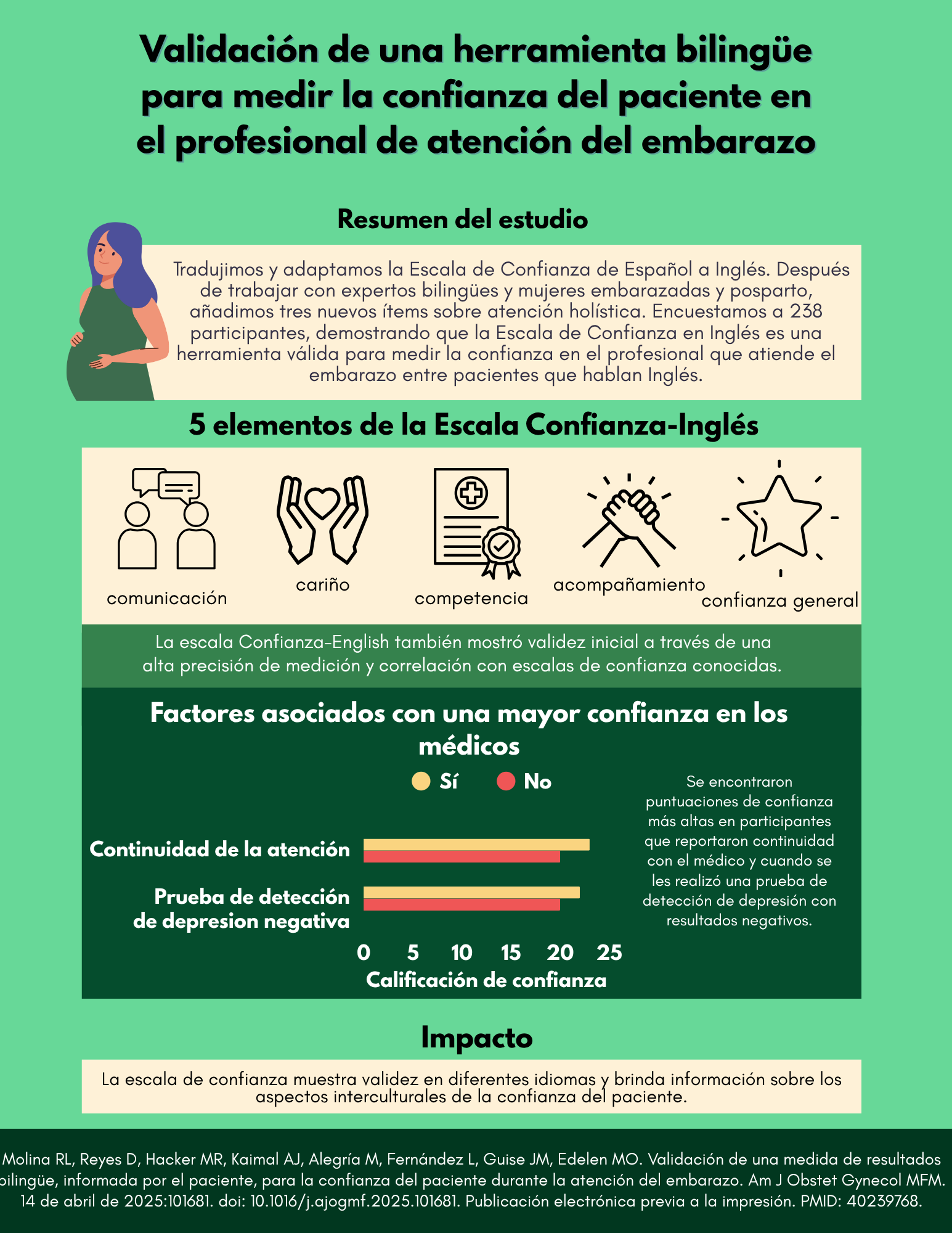
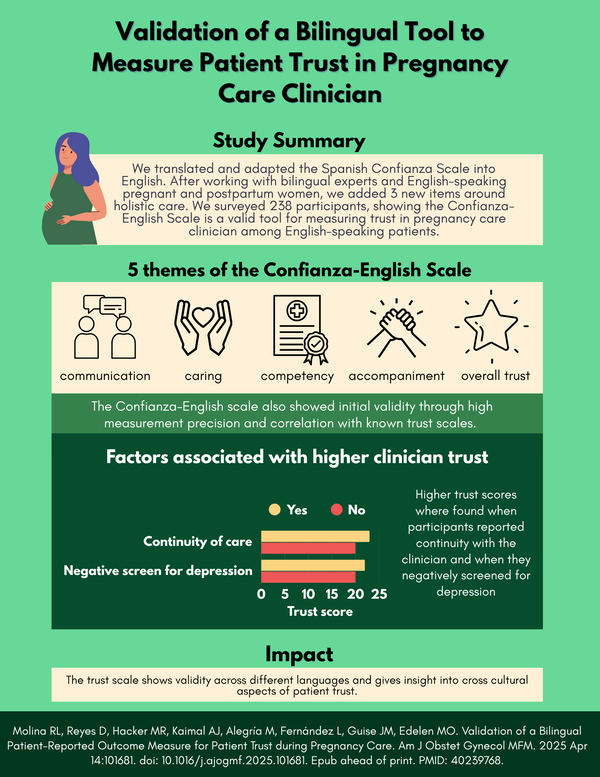
Molina RL, Bazan M, Hacker MR, et al. A Spanish-Language Patient-Reported Outcome Measure for Trust in Pregnancy Care Clinician.. JAMA network open. 2025;8(2):e2460465. doi:10.1001/jamanetworkopen.2024.60465

IMPORTANCE: Despite the importance of patient trust in health care, there are no patient-reported outcome measures (PROMs) for trust in their clinician that have been developed empirically in Spanish, which is the second most common language in the US.

OBJECTIVE: To develop and validate a Spanish-language PROM for trust in pregnancy care clinician.

DESIGN, SETTING, AND PARTICIPANTS: This cross-sectional study used a national online panel of patients who reported a Spanish language preference and had limited English proficiency and were currently pregnant or had given birth within the 12 months before the survey. Participants resided in the United States, and data were collected from January to May 2024.

EXPOSURES: Participants had clinical interactions during pregnancy and/or postpartum care. Data collected included demographics, Confianza (Trust) Scale candidate items, and 4 measures for concurrent validity evidence: the Trust in Physician Scale (TPS), the Mothers on Respect Index, the Edinburgh Postpartum Depression Scale (EPDS), and the Patient-Reported Outcomes Measurement Information System Global 10.

MAIN OUTCOMES AND MEASURES: The main outcomes were psychometric properties of the Confianza scale and its association with validated scales (validity coefficients). Item response theory (IRT) analyses were conducted to evaluate the psychometric properties of the candidate items, select the best item subset for the Confianza scale, examine its correlation with other measures, and compare scores according to demographic characteristics.

RESULTS: Of the included 204 participants (mean [SD] age, 26 [7] years; 62 participants from South America [30%]; 32 participants from Mexico [16%]), 117 participants were pregnant (57%), and 87 were within 1-year post partum (43%) at the time of survey completion. Four items were removed based on exploratory factor analysis. Using results from IRT analysis on the remaining 12 items, 5 items were selected to represent communication, caring, competency, accompaniment, and overall trust for the final measure. The 5-item Confianza scale had high measurement precision, with reliability above 0.90 across a wide range of the trust continuum. The Confianza scale (mean [SD] score, 21.5 [4.6] out of 25) was positively correlated with the TPS (r = 0.47; 95% CI, 0.36 to 0.57; P < .001) and negatively correlated with the EPDS (r = -0.41; 95% CI, -0.52 to -0.29; P <.001). Higher trust scores were obtained when there was language concordance with clinicians (mean [SD], 23.6 [2.3] vs 20.0 [5.3]; P < .001) and care continuity (mean [SD], 22.3 [3.8] vs 20.9 [5.3]; P = .001).

CONCLUSIONS AND RELEVANCE: In this cross-sectional study of pregnant and postpartum Spanish-speaking individuals, a Spanish-language PROM for trust in pregnancy care clinician had initial validity.

Fernández-Elorriaga M, Fifield J, Semrau KEA, et al. Impact of the WHO safe childbirth checklist on birth attendant behavior and maternal-newborn outcomes: A systematic review and meta-analysis.. International journal of gynaecology and obstetrics: the official organ of the International Federation of Gynaecology and Obstetrics. Published online 2025. doi:10.1002/ijgo.16123

BACKGROUND: The intrapartum period is critical for reducing maternal and perinatal morbidity and mortality. The WHO's Safe Childbirth Checklist (SCC) was designed as a reminder of the most critical, evidence-based practices (EBPs) to improve quality care and reduce preventable complications and deaths.

OBJECTIVE: To assess the impact of SCC on birth attendant behavior and maternal and newborn health outcomes.

SEARCH STRATEGY: A systematic review and meta-analysis was performed searching across five databases from 2009 to 2023.

SELECTION CRITERIA: We included randomized controlled trials, quasi-experimental studies, and pre/post studies.

DATA ANALYSIS: A meta-analysis yielded a pooled estimate of relative risk (RR) for adherence to and effectiveness of the SCC.

MAIN RESULTS: Of 1070 articles identified, 16 were included. Use of the SCC increased adherence to EBPs by 65% (RR 1.65; 95% confidence interval [CI] 1.34-2.02). The behaviors that improved the most were danger sign counseling (RR 12.37; 95% CI 1.95-78.52; P = 0.008) and pre-eclampsia management (RR 3.43; 95% CI 1.33-8.88; P = 0.011). There was moderate evidence for stillbirth reduction (RR 0.89; 95% CI 0.80-0.99; P = 0.034).

CONCLUSION: There is moderate evidence demonstrating the effectiveness of the SCC in reducing stillbirths and improving adherence to EBPs.