

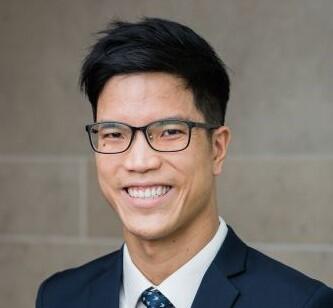
Chieh Yang (Christopher) Koo joined us this year as a post-doctoral researcher from Singapore, where he is an Adjunct Assistant Professor in the National University of Singapore's Department of Medicine and a consultant for National University's Department of Cardiology. Dr. Koo is also the vice-president of the International Cardio-Oncology Society's Singapore chapter.
Dr. Koo received his medical degree from University College London in the UK before returning to Singapore for Internal Medicine residency and two cardiology fellowships (General and Interventional) at National University. Directly following his fellowships, National University offered him an adjunct assistant professorship. In his first year of teaching, Dr. Koo received a Teaching Excellence Award; the next year, he received the bronze Public Administration Medal from Singapore's Prime Minister's Office for his efforts as the medical co-lead for Singapore's largest migrant worker dormitory during the COVID-19 pandemic.
Dr. Koo's clinical interests include coronary artery disease, interventional cardiology, and cardio-oncology. He has previously conducted research on the effects of sleep apnea on cardiovascular disease and the impact of cancer and cancer treatment on the cardiovascular system. At the Smith Center, Dr. Koo is working on two projects about the diagnostic capacities of fractional flow reserve (FFR), in addition to a project on trends in pulmonary embolism outcomes.
Below, Dr. Koo discusses his path to medicine and why he chose to come to the Smith Center.
What sparked your interest in medicine?
I thought medicine was one option which wasn't as restrictive; i.e., I could still be a teacher with a medical degree, but not vice-versa. My parents are doctors as well, so maybe some gradual influence there, but I won't say it was a spark.
Why did you choose to come work with Eric? Is there a particular aspect of his research that drew you to him?
RDN is something that I am hoping to grow back in Singapore (our current case load is really small), so when I came to Boston, I asked Medtronic if they knew who the highest volume operator was in Boston and Eric's name popped up! I managed to link up with Eric at the RDN course that he organized, and I am since very grateful for his kindness and the opportunity to work with him.
What are a few ongoing or completed projects that you would like to highlight? What do you hope the impact of these projects will be?
I'm currently mainly working on projects involving coronary physiology, which is what I enjoy a lot as an interventional cardiologist. The general theme is understanding the trends and impact on usage of FFRangio and FFR-CT (fractional flow reserve computed tomography), both which are recent advances with the aim of improving outcomes in coronary artery disease. The opportunity to access large datasets on these newer procedures here at the Smith Center is something I would have never had back in Singapore. I hope that through the use of large, real-world data, we'll be able to better understand the efficacy and impact of these novel technologies and how best to integrate them into our regular clinical practice.
Reflecting on the time you’ve spent at the Smith Center so far, what have been one or two of your biggest takeaways from conducting work with this team?
What I appreciate most is how Eric and the team are so warm and welcoming, and there really aren't any airs or hierarchy within the team. What leaves the greatest impression on me is the weekly catch-up on everyone's weekend, which I find very interesting. It just feels like people are genuinely interested in each other's lives, and I've learnt that it's a great way to get everyone going at the start of the week, and also to connect everyone in ways that we otherwise wouldn't have the chance to.
What do you hope to accomplish before you leave the Smith Center? What skills do you hope to bring back to your home institution?
I hope to finish up the projects on coronary physiology that I'm currently working on. I'm also hoping to learn more from the collaborations on pulmonary embolism, and perhaps explore options for collaboration on RDN when I'm back in Singapore! I also hope to take the soft skills that I've learnt in crafting an even better team culture back home to Singapore.

