
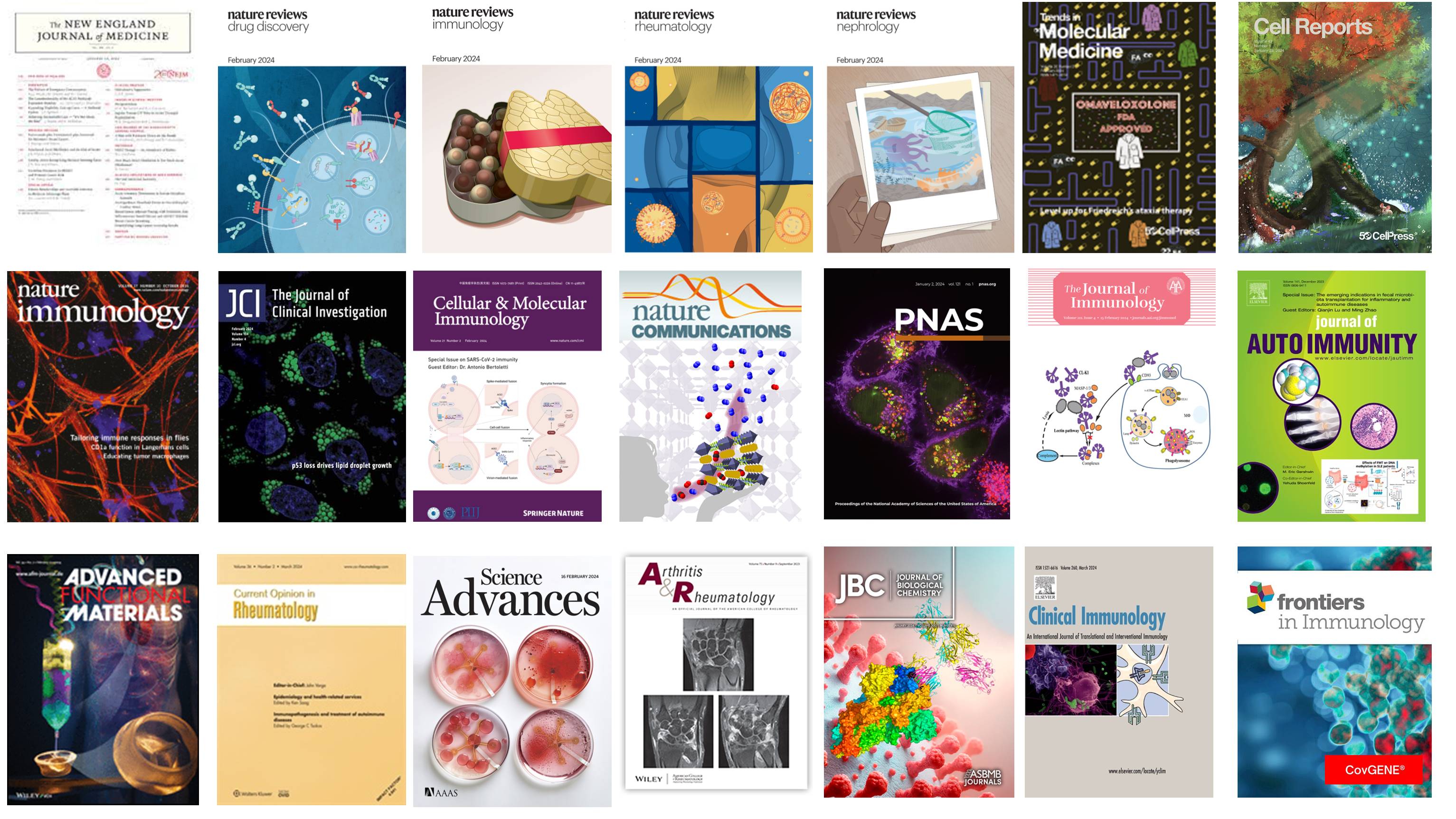
Publications

2020

Satyam, A., Andreo, K., Lapchak, P. H., Lucca, J. J. D., Davis, R. B., Tsokos, M. G., Shapiro, N. I., & Tsokos, G. C. (2020). Complement Deposition on the Surface of RBC After Trauma Serves a Biomarker of Moderate Trauma Severity: A Prospective Study. Shock, 53, Article 1. https://doi.org/10.1097/SHK.000000000000134800024382-202001000-00003 [pii]
BACKGROUND: Activation of the complement system and complement deposition on red blood cells (RBCs) contribute to organ damage in trauma. We conducted a prospective study in subjects with traumatic injuries to determine the pattern of complement deposition on RBC and whether they are associated with clinical outcomes. METHOD: A total of 124 trauma patients and 42 healthy controls were enrolled in this prospective study. RBC and sera were collected at 0, 6, 24, and 72 h from trauma patients and healthy controls during a single draw. Presence of C4d, C3d, C5b-9, phosphorylation of band 3 and production of nitric oxide were analyzed by flow cytometry. RESULTS: RBC from trauma patients at all time points up to 24 h displayed significantly higher deposition of C4d on their RBC membrane as compared with healthy donors. Incubation of normal RBC with sera from trauma patients resulted in significant increase of C4d deposition (at 0, 6, 24, and 72 h), C5b-9 deposition (at 0 and 6 h), phosphorylation of band 3 (at 0 and 24 h), and nitric oxide production up to 24 h compared with sera from healthy subjects. Deposition of C4d and C5b-9 in patients with an Injury Severity Score (ISS) of 9 and above remained elevated up to 72 h. CONCLUSIONS: Our study demonstrates that the presence of C4d, C3d, and C5b-9 on the surface of RBC is linked to increased phosphorylation of band 3 and increased production of nitric oxide. Deposition of C4d and C5b-9 decreased faster over course of 3-day study in subjects with ISS less than 9.
Rodriguez-Rodriguez, N., Madera-Salcedo, I. K., Cisneros-Segura, J. A., Garcia-Gonzalez, H. B., Apostolidis, S. A., Saint-Martin, A., Esquivel-Velazquez, M., Nguyen, T., Romero-Rodriguez, D. P., Tsokos, G. C., Alcocer-Varela, J., Rosetti, F., & Crispin, J. C. (2020). Protein phosphatase 2A B55beta limits CD8+ T cell lifespan following cytokine withdrawal. J Clin Invest, 130, Article 11. https://doi.org/129479 [pii]10.1172/JCI129479
How T cells integrate environmental cues into signals that limit the magnitude and length of immune responses is poorly understood. Here, we provide data that demonstrate that B55beta, a regulatory subunit of protein phosphatase 2A, represents a molecular link between cytokine concentration and apoptosis in activated CD8+ T cells. Through the modulation of AKT, B55beta induced the expression of the proapoptotic molecule Hrk in response to cytokine withdrawal. Accordingly, B55beta and Hrk were both required for in vivo and in vitro contraction of activated CD8+ lymphocytes. We show that this process plays a role during clonal contraction, establishment of immune memory, and preservation of peripheral tolerance. This regulatory pathway may represent an unexplored opportunity to end unwanted immune responses or to promote immune memory.
Satyam, A., & Tsokos, G. C. (2020). Curb complement to cure COVID-19. Clin Immunol, 221, 108603. https://doi.org/S1521-6616(20)30763-4 [pii]10.1016/j.clim.2020.108603108603 [pii]
Sharabi, A., & Tsokos, G. C. (2020). T cell metabolism: new insights in systemic lupus erythematosus pathogenesis and therapy. Nat Rev Rheumatol, 16, Article 2. https://doi.org/10.1038/s41584-019-0356-x10.1038/s41584-019-0356-x [pii]
T cell subsets are critically involved in the development of systemic autoimmunity and organ inflammation in systemic lupus erythematosus (SLE). Each T cell subset function (such as effector, helper, memory or regulatory function) is dictated by distinct metabolic pathways requiring the availability of specific nutrients and intracellular enzymes. The activity of these enzymes or nutrient transporters influences the differentiation and function of T cells in autoimmune responses. Data are increasingly emerging on how metabolic processes control the function of various T cell subsets and how these metabolic processes are altered in SLE. Specifically, aberrant glycolysis, glutaminolysis, fatty acid and glycosphingolipid metabolism, mitochondrial hyperpolarization, oxidative stress and mTOR signalling underwrite the known function of T cell subsets in patients with SLE. A number of medications that are used in the care of patients with SLE affect cell metabolism, and the development of novel therapeutic approaches to control the activity of metabolic enzymes in T cell subsets represents a promising endeavour in the search for effective treatment of systemic autoimmune diseases.
Satyam, A., Tsokos, M. G., Tresback, J. S., Zeugolis, D. I., & Tsokos, G. C. (2020). Cell derived extracellular matrix-rich biomimetic substrate supports podocyte proliferation, differentiation and maintenance of native phenotype. Adv Funct Mater, 30, Article 44. https://doi.org/1908752 [pii]10.1002/adfm.201908752
Current technologies and available scaffold materials do not support long-term cell viability, differentiation and maintenance of podocytes, the ultra-specialized kidney resident cells that are responsible for the filtration of the blood. We developed a new platform which imitates the native kidney microenvironment by decellularizing fibroblasts grown on surfaces with macromolecular crowding. Human immortalized podocytes cultured on this platform displayed superior viability and metabolic activity up to 28 days compared to podocytes cultured on tissue culture plastic surfaces. The new platform displayed a softer surface and an abundance of growth factors and associated molecules. More importantly it enabled podocytes to display molecules responsible for their structure and function and a superior development of intercellular connections/interdigitations, consistent with maturation. The new platform can be used to study podocyte biology, test drug toxicity and determine whether sera from patients with podocytopathies are involved in the expression of glomerular pathology.
Tsokos, G. C. (2020). Autoimmunity and organ damage in systemic lupus erythematosus. Nat Immunol, 21, Article 6. https://doi.org/10.1038/s41590-020-0677-610.1038/s41590-020-0677-6 [pii]
Impressive progress has been made over the last several years toward understanding how almost every aspect of the immune system contributes to the expression of systemic autoimmunity. In parallel, studies have shed light on the mechanisms that contribute to organ inflammation and damage. New approaches that address the complicated interaction between genetic variants, epigenetic processes, sex and the environment promise to enlighten the multitude of pathways that lead to what is clinically defined as systemic lupus erythematosus. It is expected that each patient owns a unique 'interactome', which will dictate specific treatment.
Tsokos, G. C., & Terhorst, C. (2020). T Lymphocytes Cash Their Value in Clinical Medicine. Trends Mol Med, 26, Article 9. https://doi.org/S1471-4914(20)30154-4 [pii]10.1016/j.molmed.2020.06.003
Empowering the ability of cytotoxic T cells to kill tumor cells or the reframing of their receptor to eliminate cancer cells has revolutionized cancer treatment. Simultaneously, the empowering of regulatory subsets has met success in mitigating autoimmune diseases. T cells, the major first responders of the immune system, are produced in the thymus, an organ that serves as their 'training camp'. On their exit to the periphery, T cells are effector cells that control infections or regulatory cells, which limit excessive responses.
Tsokos, G. C. (2020). Notch notches lupus. Kidney Int, 97, Article 2. https://doi.org/S0085-2538(19)31059-2 [pii]10.1016/j.kint.2019.10.018
The multifaceted Notch signaling pathway appears to tame the autoimmune response and protect lupus-prone mice from inflammation and damage.
Vukelic, M., Kono, M., & Tsokos, G. C. (2020). T cell Metabolism in Lupus. Immunometabolism, 2, Article 2. https://doi.org/e200009 [pii]10.20900/immunometab20200009
Abnormal T cell responses are central to the development of autoimmunity and organ damage in systemic lupus erythematosus. Following stimulation, naive T cells undergo rapid proliferation, differentiation and cytokine production. Since the initial report, approximately two decades ago, that engagement of CD28 enhances glycolysis but PD-1 and CTLA-4 decrease it, significant information has been generated which has linked metabolic reprogramming with the fate of differentiating T cell in health and autoimmunity. Herein we summarize how defects in mitochondrial dysfunction, oxidative stress, glycolysis, glutaminolysis and lipid metabolism contribute to pro-inflammatory T cell responses in systemic lupus erythematosus and discuss how metabolic defects can be exploited therapeutically.