

Research
Liver Organoids
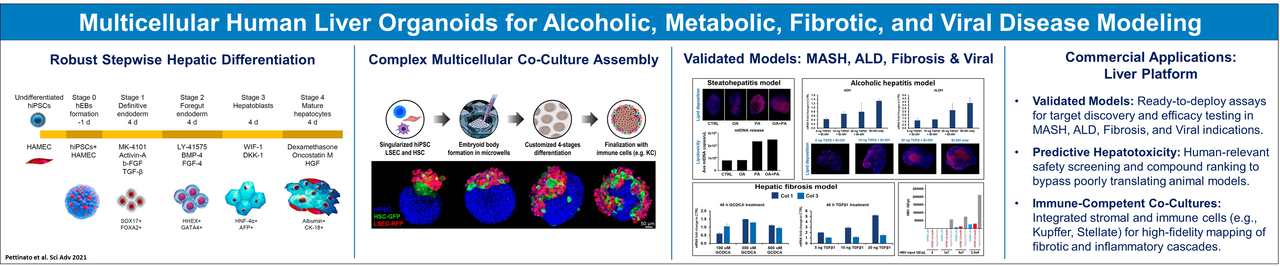
Multicellular Human Liver Organoids
At the Stem Cells and Organoids Research & Engineering (SCORE) Center, we develop and apply multicellular human liver organoid systems as physiologically relevant platforms for investigating liver biology, disease mechanisms, and therapeutic interventions. By integrating hepatocyte-like cells with non-parenchymal cell populations, including hepatic stellate cells and liver sinusoidal endothelial cells, these three-dimensional systems recapitulate key features of the hepatic microenvironment and cellular interactions that are not adequately represented by conventional hepatocyte monocultures. Our platform combines a proprietary agarose micromold-based technology for generating uniform, scaffold-free cellular aggregates with directed hepatic differentiation, enabling reproducible organoid formation and functional characterization. These multicellular liver organoids support the investigation of hepatocyte–stromal and hepatocyte–endothelial interactions in physiological and pathological contexts, including metabolic dysfunction-associated steatotic liver disease (MASLD/MASH), alcohol-associated liver disease, and chronic hepatitis B virus (HBV) infection. In particular, HBV-infected liver organoids provide a human-relevant model for studying viral persistence, covalently closed circular DNA (cccDNA), and immune-mediated antiviral responses, including interactions between infected hepatocytes and antigen-specific T cells. By preserving multicellular complexity within a controlled experimental system, the SCORE Center's liver organoid research aims to advance mechanistic understanding of liver disease, facilitate the evaluation of novel therapeutic strategies, and establish more predictive human-relevant models for translational research.
Pancreatic Organoids
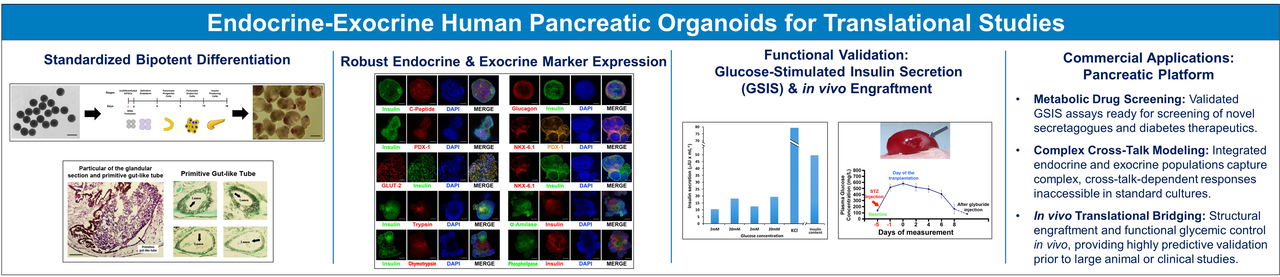
Human Pancreatic Organoids Integrating Endocrine and Exocrine Compartments
At the Stem Cells and Organoids Research & Engineering (SCORE) Center, we develop human pancreatic organoid models that incorporate both endocrine and exocrine compartments within the same three-dimensional structure. This integrated organization provides a unique opportunity to investigate pancreatic biology in a system that brings together the insulin-producing endocrine compartment and the enzyme-producing exocrine compartment, reflecting the fundamental functional organization of the native pancreas. Unlike conventional models that study pancreatic endocrine and exocrine tissues separately, our platform enables the investigation of their respective properties within a shared organoid architecture, opening new avenues for studying tissue organization, cellular function, and interactions between pancreatic compartments. This approach is particularly relevant to research on diabetes, pancreatic dysfunction, and diseases in which endocrine and exocrine pathologies may be interconnected. The platform also provides opportunities to investigate stem cell-derived pancreatic tissue, characterize organoid maturation and function, and evaluate therapeutic strategies aimed at preserving or restoring pancreatic function. By integrating endocrine and exocrine features in a single experimental system, the SCORE Center aims to advance more comprehensive and physiologically relevant models of human pancreatic biology, supporting mechanistic studies, disease modeling, and the development of regenerative and translational approaches.
Intestinal Organoids
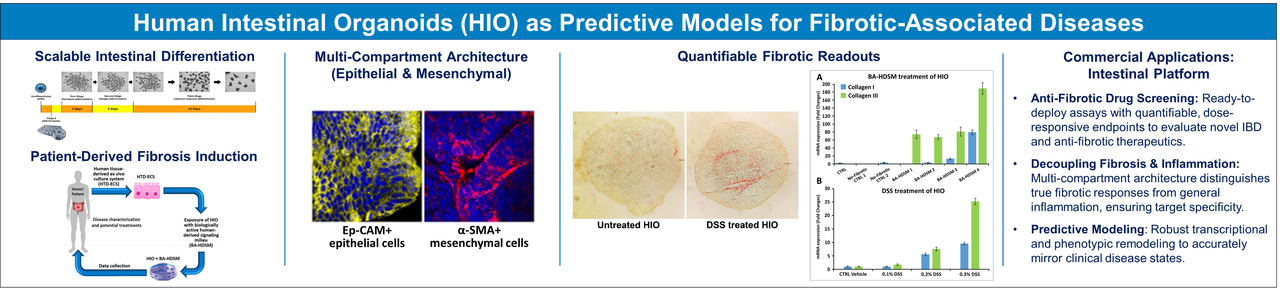
Human Intestinal Organoids
At the Stem Cells and Organoids Research & Engineering (SCORE) Center, we develop and apply human induced pluripotent stem cell (hiPSC)-derived intestinal organoids to investigate intestinal physiology, disease mechanisms, and therapeutic responses, with a particular focus on inflammatory bowel disease (IBD), including Crohn’s disease, and intestinal fibrosis. Unlike conventional intestinal organoid models, which are typically established from patient biopsies or intestinal cell lines, our platform uses directed differentiation of hiPSCs to generate intestinal organoids, providing a reproducible and adaptable system for modeling human intestinal disease. Our proprietary agarose micromold technology enables the formation of uniform, free-floating three-dimensional organoids without encapsulation in extracellular matrix domes, while offering the flexibility to generate organoids from alternative cellular sources when required by specific research applications. By combining this approach with molecular and functional analyses, we investigate disease-associated cellular responses, mechanisms of intestinal inflammation and fibrotic remodeling, and variability in disease phenotypes. Our goal is to establish hiPSC-derived intestinal organoids as predictive, human-relevant models for IBD and other intestinal disorders, supporting the investigation of disease mechanisms, evaluation of therapeutic responses, and development of more personalized approaches to intestinal disease research.
Brain Organoids

Brain Organoids
Neuronal activity increases lactate production, contributing to local acidification of brain pH. ATP released during neuronal activity activates astrocytic P2Y1 receptors, triggering bicarbonate production and transport via SLC4A4 to buffer extracellular H+, leading to a relatively acidic intracellular pH in astrocytes. Brain pH is normally lower than blood pH and is further reduced in schizophrenia and bipolar disorder. In our postmortem studies, lower brain pH is linked to increased expression of TGFB2 and over 300 genes, particularly astrocytic genes. Lactic acid treatment of iPSC-derived astrocytes and brain organoids reproduced disease-related gene expression and epigenetic alterations, supporting the use of brain organoids to model lactate/pH-driven pathology or treatment strategies.
Cancer Organoids
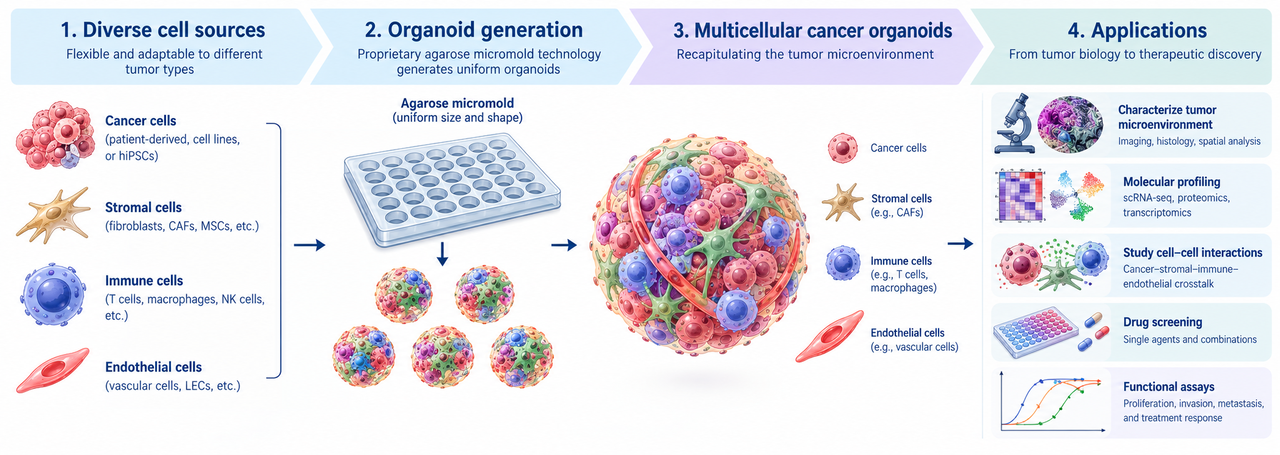
Cancer Organoids
At the Stem Cells and Organoids Research & Engineering (SCORE) Center, we develop and apply three-dimensional cancer organoid models to investigate tumor biology, disease mechanisms, and therapeutic responses. Our proprietary agarose micromold technology enables the generation of uniform cancer organoids from diverse cellular sources and can be adapted to different tumor types and research applications. A key feature of this platform is its flexibility to incorporate multiple cell populations within the same organoid, enabling the study of interactions between cancer cells and components of the tumor microenvironment, including stromal and immune cells. This approach provides a versatile experimental system for investigating tumor–microenvironment interactions, cancer progression, and treatment responses, with the broader goal of advancing human-relevant models for mechanistic cancer research and preclinical therapeutic evaluation.
Recent Publications
Contact us
SCORE Center
Beth Israel Deaconess Medical Center
Research North, Room RN0245
99 Brookline Avenue
Boston MA, 02215
