
Immigrant Maternal & Reproductive Health Policy
Background
Objective
Methods
Results
Conclusions
Immigrants face challenges in navigating complex policies that govern access to health care, shelter, food, and clean water, resulting in profound effects on health care outcomes, including increased risk of preterm births and decreased access to preventive health services. These disparities are further exacerbated when immigration policies result in mass detention, incarceration, and deportation, leading to profound trauma among undocumented immigrants and their communities. Obstetrician–gynecologists and other reproductive health care professionals should be prepared to practice immigration-informed care and ensure clinical spaces are welcoming to immigrants. Unless mandated by law, health care professionals should document only information related to a patient's migration history that is necessary for the ongoing clinical care. Health care institutions should provide robust guidance and support for health care personnel and patients faced with the continued complexities of the dynamic landscape of immigration policies. Obstetrician–gynecologists should advocate for the unique needs of patients who are immigrants to promote reproductive justice and health equity.
Reproductive coercion extends from a historical context in which the obstetrics and gynecology profession has interfered with the reproductive and bodily autonomy of immigrants. We provide illustrative examples of historical and contemporary immigration policies that allow mechanisms of reproductive control to persist within the immigration detention system. We end by compelling obstetrician–gynecologists to act as agents of change by leveraging their social, economic, and political power to resist and eliminate structures and norms that enable reproductive oppression of immigrant groups in detention.
With the entry of U.S. immigration enforcement into health facilities and health records since January 2025, timely questions have arisen over data justice and patient trust in health care. Although guidelines for the collection and analysis of demographic data promote statistical nuance and data disaggregation, not all patients will want to provide details about their personal information and may interpret these questions as especially intrusive or risky in the current sociopolitical context. Reckoning with the motives that cause patients to mask potentially sensitive information is a necessary path forward for health systems and an actionable way for health care spaces to become as welcoming and inclusive of immigrants as possible. Health care leaders and the systems they represent can proactively approach patient nondisclosure with care by providing abundantly transparent communication over the use of personal information, avoiding documentation of certain questions—like immigration status—altogether, and affirming nonresponse as a valid and welcome response.
The political environment and legal decisions in the United States (US) can impact lives around the globe. A recent attack on women’s sexual and reproductive health and rights (SRHR) occurred in June 2018 when former US Attorney General Jeff Sessions reversed a decision (Matter of A-R-C-G-) in which domestic violence was recognised as a basis for asylum.Citation1 Domestic violence is one form of gender-based violence, encompassing sexual and physical assault and reproductive coercion, which disproportionately harm women. Given the global epidemic of gender-based violence, we argue that Sessions’ reversal of this decision and efforts to rollback protection for domestic violence survivors could have far-reaching impacts on women around the world. This article will provide some recommendations for medical and legal professionals in response to this affront on SRHR.
Reproductive coercion extends from a historical context in which the obstetrics and gynecology profession has interfered with the reproductive and bodily autonomy of immigrants. We provide illustrative examples of historical and contemporary immigration policies that allow mechanisms of reproductive control to persist within the immigration detention system. We end by compelling obstetrician-gynecologists to act as agents of change by leveraging their social, economic, and political power to resist and eliminate structures and norms that enable reproductive oppression of immigrant groups in detention.
BACKGROUND: Undocumented immigrants face many barriers in accessing pregnancy care, including language differences, implicit and explicit bias, limited or no insurance coverage, and fear about accessing services. With the national spotlight on maternal health inequities, the current literature on undocumented immigrants during pregnancy requires synthesis.
OBJECTIVE: We aimed to describe the literature on pregnancy care utilization, experiences, and outcomes of undocumented individuals in the United States.
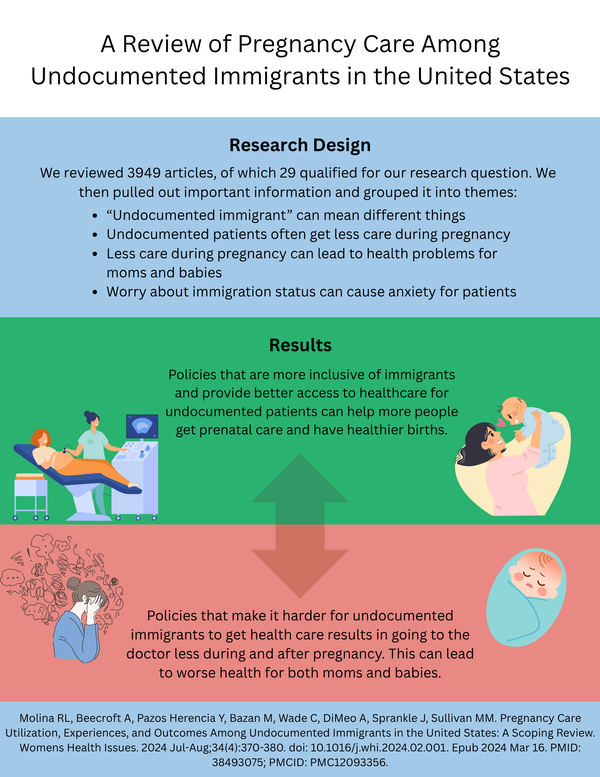
METHODS: We performed a scoping review of original research studies in the United States that described the undocumented population specifically and examined pregnancy care utilization, experiences, and outcomes. Studies underwent title, abstract, and full-text review by two investigators. Data were extracted and synthesized using descriptive statistics and content analysis.
RESULTS: A total of 5,940 articles were retrieved and 3,949 remained after de-duplication. After two investigators screened and reviewed the articles, 29 studies met inclusion criteria. The definition of undocumented individuals varied widely across studies. Of the 29 articles, 24 showed that undocumented status and anti-immigrant policies and rhetoric are associated with lower care utilization and worse pregnancy outcomes, while inclusive health care and immigration policies are associated with higher levels of prenatal and postnatal care utilization as well as better pregnancy outcomes.
CONCLUSIONS: The small, heterogeneous literature on undocumented immigrants and pregnancy care is fraught with inconsistent definitions, precluding comparisons across studies. Despite areas in need of further research, the signal among published studies is that undocumented individuals experience variable access to pregnancy care, heightened fear and stress regarding their status during pregnancy, and worse outcomes compared with other groups, including documented immigrants
Insurance coverage for prenatal care, labor and delivery care, and postpartum care for undocumented immigrants consists of a patchwork of state and federal policies, which varies widely by state. According to federal law, states must provide coverage for labor and delivery through Emergency Medicaid. Various states have additional prenatal and postpartum coverage for undocumented immigrants through policy mechanisms such as the Children's Health Insurance Program's "unborn child" option, expansion of Medicaid, and independent state-level mechanisms. Using a search of state Medicaid and federal government websites, we found that 27 states and the District of Columbia provide additional coverage for prenatal care, postpartum care, or both, while 23 states do not. Twelve states include any postpartum coverage; 7 provide coverage for 12 months postpartum. Although information regarding coverage is available publicly online, there exist many barriers to access, such as lack of transparency, lack of availability of information in multiple languages, and incorrect information. More inclusive and easily accessible policies are needed as the first step toward improving maternal health among undocumented immigrants, a population trapped in a complicated web of immigration policy and a maternal health crisis. (Am J Public Health. 2024;114(10):1051-1060. https://doi.org/10.2105/AJPH.2024.307750).