

Education Research
About CERTAIN
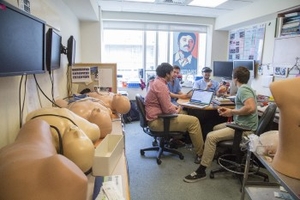
The Center for Education Research, Technology, and Innovation (CERTAIN) in the Department of Anesthesia, Critical Care, and Pain Medicine creates an environment of educational excellence through a process of continuous learning, assessment, and feedback, under the leadership of Dr. Robina Matyal.
CERTAIN conducts wide-ranging educational research, uses findings to improve our programs, and evaluates those programs to maintain heightened learning and satisfaction. We use state-of-the-art technology to create innovative teaching and assessment methods that allow us to tailor educational efforts to individual trainees and focus on their learning needs. Our ongoing cycle of quality improvement ensures that our anesthesia educational programs are among the best in the country.
In addition, the Center also fosters a supportive, collaborative environment for faculty to engage in educational scholarship. We provide mentorship, guidance, and support in areas such as study design, grant preparation, methodology, IRB correspondence, and manuscript preparation and submission.
CERTAIN faculty members and their collaborators also publish a journal, Clinics in Medical Education, that includes the most up-to-date information about teaching and learning based on current research and their own extensive experience with trainees and other learners. The journal also includes clinical cases that can be used in teaching. Check out the Clinics website below that contains all of the issues to date.
Clinics in Medical Education
About Us
Mission Statement
The Center seeks to develop, test, and deploy a dynamic educational environment that optimizes learning for all department members and enhances patient outcomes. Through collaborative research that uses state-of-the-art technology to identify the best educational methods, CERTAIN aims to continually enhance our existing programs and create new and innovative systems for teaching and learning.
Goals
- Create an optimal learning environment for our department members as well as members of other departments.
- Develop and apply innovative metrics to evaluate and enhance our educational programs.
- Use state-of-the-art technology to create, assess, and deploy new learning tools and methods.
- Refine techniques to teach complex technical skills to our department members.
- Provide mentorship, support, and guidance to faculty pursuing educational research.
Education Research
CERTAIN focuses on developing innovative methods to improve education for both medical trainees and faculty. Its primary focus is on establishing pre-clinical proficiency: an objective demonstration of “readiness to perform” prior to actual clinical exposure.
Training Sessions & Courses
The Center hosts training sessions and courses for various learners in the medical center. From academic days for our department’s CA-1 residents to ultrasound courses for other departments, including Nephrology and Hospital Medicine, CERTAIN emphasizes a multimodal teaching approach that utilizes online modules hosted on a learning management system developed and managed by the department, in-person lectures and case discussions, and hands-on practice on simulators and live models. These training sessions and courses occur in our dedicated Anesthesia Skills Lab and strive to improve learners’ knowledge, skills, and workflow understanding for procedures ranging from intubations to ultrasound-guided vascular access to echocardiography. With CERTAIN’s support, Dr. Ruma Bose was awarded a Foundation for Anesthesia Education and Research grant to fund the development of a rescue ultrasound curriculum for senior residents that uses mixed reality.
Pedagogy
CERTAIN is at the forefront of developing different methods for teaching. Dr. Daniel Walsh recently created an online Journal Club curriculum to increase intraoperative teaching and is working with residents and fellows to develop interactive branched chain learning modules for various subspecialties. Dr. Matyal is leading an effort to increase peer-assisted teaching in the department, where senior residents train junior residents through case discussions and just-in-time hands-on learning. In addition, Dr. Nadav Levy is working to implement in-situ simulation training for faculty and residents.
Technology & Innovation
CERTAIN is leading an initiative to work with virtual reality (VR) and augmented reality (AR) simulation companies to develop VR simulators for teaching procedural skills, such as transthoracic echocardiography (TTE) and ultrasound-guided regional anesthesia, as well as teamwork skills. The Center also supports research using new technologies for teaching, such as Dr. Haobo Ma’s study on teaching fiberoptic intubation skills using 3-dimensional (3D) printing technology, which was awarded with a Society for Education in Anesthesia SEAd grant. CERTAIN is also collaborating with Interventional Radiology in a CRICO-funded study on using motion metrics to assess and provide objective feedback to residents learning central venous catheter placement skills.

