

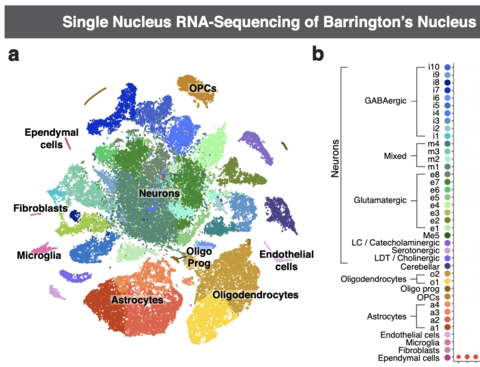
This study revealed a brainstem mechanism that controls the brain-bladder axis in a sex-specific way. Dr. Verstegen and her team characterized a newly identified enkephalinergic population in Barrington’s nucleus (BarPenk) that selectively modulates external urethral sphincter (EUS) activity and is essential for scent-marking behavior in male mice, a well-established proxy for voluntary micturition in rodents.
Few bodily functions depend as strongly on coordinated brain-body interactions as lower urinary tract (LUT) control. LUT control requires the integration of sensory signals from the bladder with descending motor commands that initiate or suppress voiding.
Although Barrington’s nucleus (Bar) has long been recognized as a supraspinal hub regulating LUT function, the molecular identities and functional specializations of its constituent neurons have remained largely undefined. This work addresses that gap through a multi-scale analysis that defines cell-type architecture, circuit connectivity, and the behavioral roles of Bar neurons, revealing their selective contributions to reflexive and voluntary LUT regulation.

