

Our research focuses on mitigating the deleterious effects of spaceflight on the skeleton. Using both clinical investigations in astronauts and experimental studies in animal models, we examine how microgravity disrupts bone remodeling, compromises skeletal integrity, and alters cellular and molecular signaling. By testing countermeasures such as artificial gravity, mechanical loading, and pharmacologic interventions, we aim to preserve bone mass and function during space missions and to apply these insights to improve bone health on Earth.
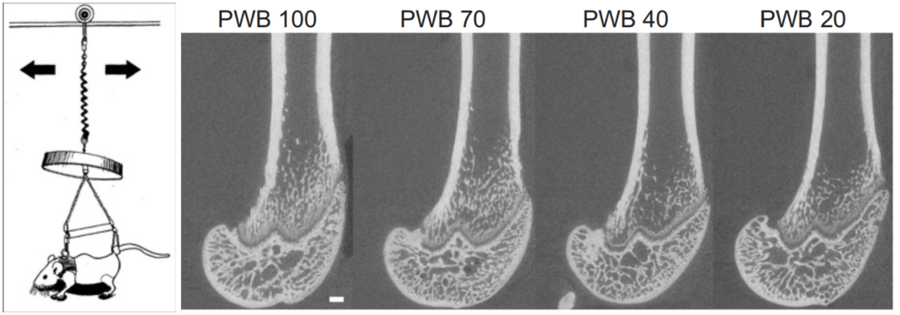
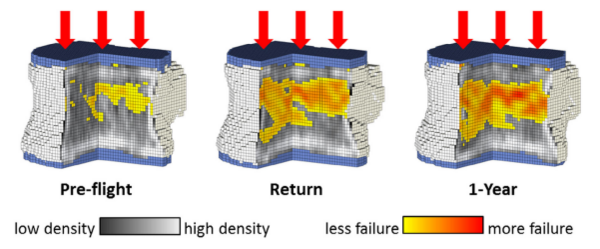
We are collaborating with NASA as part of the Complement of Integrated Protocols for Human Exploration Research program (CIPHER), which aims to study the effects of spaceflight on several body systems. Our aim is to evaluate the effect of different mission durations on bone structure and strength, as well as changes to muscle on return to earth and after readaptation to normal gravity.
Recent Publications
Coulombe, J. C., Johannesdottir, F., Burkhart, K. A., Brummer, H., Allaire, B. T., & Bouxsein, M. L. (2023). Changes in Vertebral Bone Density and Paraspinal Muscle Morphology Following Spaceflight and 1 Year Readaptation on Earth. Journal of Bone and Mineral Research Plus, 7(12), e10810.
Rosa-Caldwell, M. E., Mortreux, M., Wadhwa, A., Kaiser, U. B., Sung, D. M., Bouxsein, M. L., & Rutkove, S. B. (2023). Sex differences in muscle health in simulated micro-and partial-gravity environments in rats. Sports Medicine and Health Science, 5(4), 319-328.
Burkhart, K., Allaire, B., Anderson, D. E., Lee, D., Keaveny, T. M., & Bouxsein, M. L. (2020). Effects of long‐duration spaceflight on vertebral strength and risk of spine fracture. Journal of Bone and Mineral Research, 35(2), 269-276.
Burkhart, K., Allaire, B., & Bouxsein, M. L. (2019). Negative effects of long-duration spaceflight on paraspinal muscle morphology. Spine, 44(12), 879-886.
