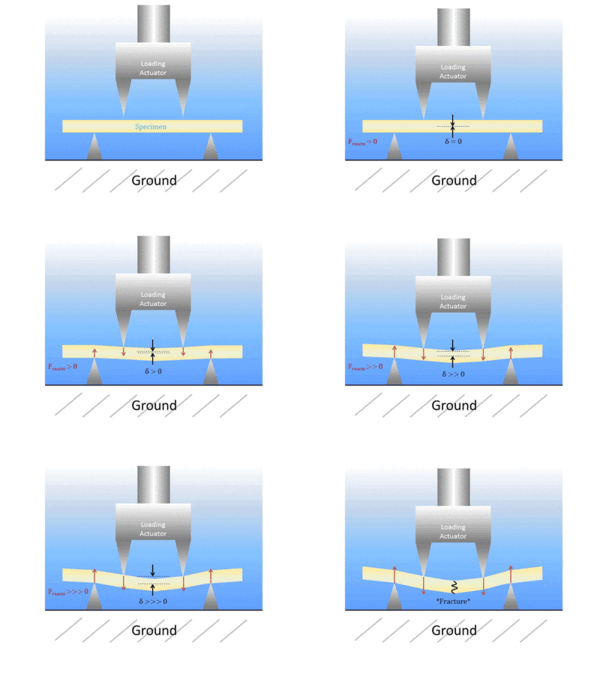
Although imaging is often used as a surrogate to evaluate bone fragility, direct measurements of mechanical strength are undoubtedly the gold standard for providing information about the mechanical integrity of bone.
Our lab offers a variety of mechanical testing options for measuring the mechanical properties of bone samples. We have a number of testing machines that allow for testing samples ranging from the size of mouse bones all the way up to human bones. Typical types of testing that we perform include 3 and 4-point bending of long bones and compression testing of vertebra, however we have the capability of performing other types of testing based on our client’s research questions. Testing outcomes typically include structural properties such stiffness, ultimate load, and energy to fracture as well as apparent material properties such as modulus, ultimate stress (strength), and toughness. Calculation of apparent material properties typically requires that we perform microCT analysis on the samples prior to testing to measure the geometry and structure of the samples. As an alternative to testing samples in the lab, we also have the ability to perform micro-finite element analysis (mFEA) to model compression of vertebrae and other samples to predict the stiffness, ultimate load, and modulus of the sample. Please also see our Reference Point Indentation page for information about the tissue level mechanical testing that we offer.
Our testing equipment:
BOSE ElectroForce 3230 (Axial-torsional tester that is ideal for high-res testing of small samples)
Instron 8511 (Axial servo-hydraulic testing machine capable of loads up to 10 kN)
Instron 8874 (Axial-torsional servo-hydraulic testing machine capable of loads up to 25 kN)