

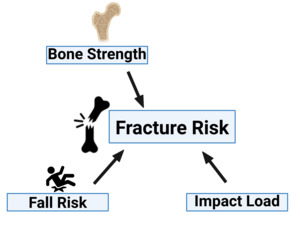
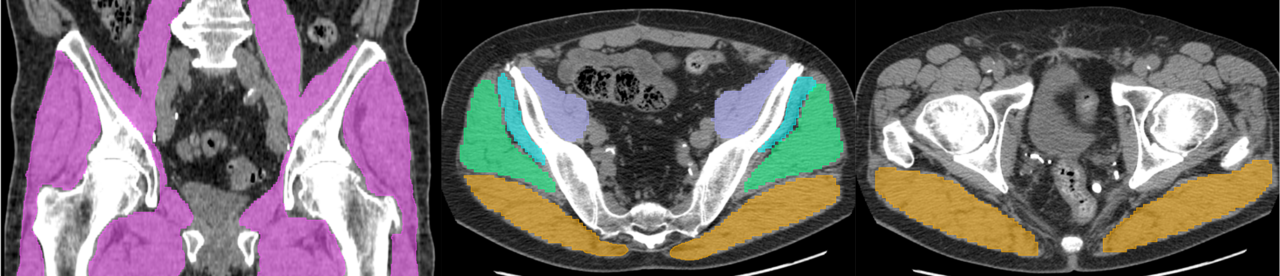
Our research focuses on understanding musculoskeletal health, particularly in the context of aging, osteoporosis, diabetes (T1D and T2D). We employ advanced non-invasive and in vivo quantitative imaging techniques, along with ex vivo bone specimen analyses and preclinical studies, to assess bone and muscle quality and identify imaging-based biomarkers of skeletal fragility. We use cutting-edge imaging and statistical algorithms to investigate the mechanisms underlying age-related changes in bone and muscle, their impact on bone strength and fracture risk, and factors contributing to falls and fractures in older adults and individuals with diabetes. Altogether, these research activities may lead to improved management of patients with osteoporosis and diabetes-related skeletal fragility, facilitating the development of effective strategies to prevent fractures in these populations.
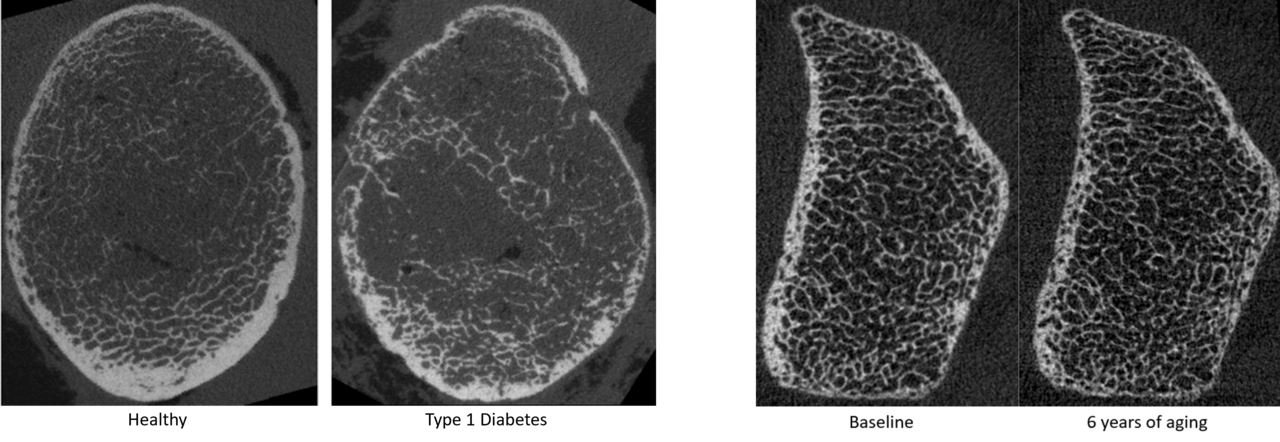
For example, patients with diabetes have 2-3 times greater bone fracture risk than non-diabetics. This increased risk occurs despite these patients having normal to high bone mineral density, which usually is protective against fractures. Thus, causes of diabetic skeletal fragility are largely unknown and there is limited information on which clinicians can base decisions for fracture prevention.
Recent Publication
Johannesdottir F, Aspelund T, Mahar S, Sigurdsson S, Gudnason V, Bouxsein ML. The relationship between fall risk, trochanteric soft tissue thickness, and hip fracture risk in older adults. J Bone Miner Res. 2025 Oct 31:zjaf161. doi: 10.1093/jbmr/zjaf161. Epub ahead of print. PMID: 41172142. (PUBMED)
Emerzian, S. R., Hanlon, J., Behzad, R., Unal, M., Brooks, D. J., Wu, I. H., ... & Bouxsein, M. L. (2025). Effect of type 1 and type 2 diabetes on human femoral trabecular bone composition, microarchitecture, and mechanical behavior. Bone, 117588.
Emerzian, S. R., Chow, J., Behzad, R., Unal, M., Brooks, D. J., Wu, I. H., ... & Bouxsein, M. L. (2025). Long-duration type 1 diabetes is associated with deficient cortical bone mechanical behavior and altered matrix composition in human femoral bone. Journal of Bone and Mineral Research, 40(1), 87-99.
Emerzian, S. R., Johannesdottir, F., Lee, D. C., Wu, I. H., Jangolla, S. V. T., Yu, M. G., ... & Bouxsein, M. L. (2025). Femora from adults with type 1 or type 2 diabetes have lower bone strength and smaller hip geometry. JBMR Plus, ziaf127.
Johannesdottir, F., Tedtsen, T., Cooke, L. M., Mahar, S., Zhang, M., Nustad, J., ... & Bouxsein, M. L. (2024). Microvascular disease and early diabetes onset are associated with deficits in femoral neck bone density and structure among older adults with longstanding type 1 diabetes. Journal of Bone and Mineral Research, 39(10), 1454-1463.
Emerzian, S. R., Johannesdottir, F., Yu, E. W., & Bouxsein, M. L. (2024). Use of noninvasive imaging to identify causes of skeletal fragility in adults with diabetes: a review. JBMR plus, 8(2), ziae003.
