


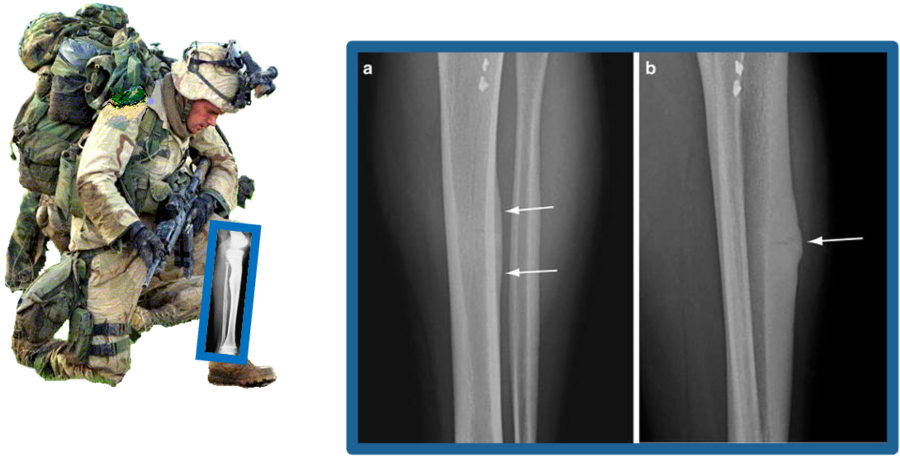
Working in partnership with USARIEM through the ARMI study, we investigate why some recruits are more vulnerable to stress fractures during basic training. Our research combines state-of-the-art imaging, physical performance testing, and biomarker analysis to pinpoint risk factors and guide prevention strategies. The ultimate goal is to keep service members healthy, resilient, and mission-ready while informing approaches to stress fracture prevention in athletes and other physically active populations.
Relevant Publications
Gaffney-Stomberg, E., Hughes, J. M., Guerriere, K. I., Staab, J. S., Cable, S. J., Bouxsein, M. L., & McClung, J. P. (2022). Once daily calcium (1000ámg) and vitamin D (1000áIU) supplementation during military training prevents increases in biochemical markers of bone resorption but does not affect tibial microarchitecture in Army recruits. Bone, 155, 116269.
Hughes, J. M., Gaffney-Stomberg, E., Guerriere, K. I., Taylor, K. M., Popp, K. L., Xu, C., ... & Bouxsein, M. L. (2018). Changes in tibial bone microarchitecture in female recruits in response to 8 weeks of US Army Basic Combat Training. Bone, 113, 9-16.
Bouxsein, M. L., & Popp, K. (2016). Risk Stratification of Stress Fractures and Prediction of Return-to-Duty.
Bulathsinhala, Lakmini, et al. "Risk of stress fracture varies by race/ethnic origin in a cohort study of 1.3 million US Army soldiers." Journal of bone and mineral research 32.7 (2017): 1546-1553.
