
Publications

Journal Article

[This corrects the article DOI: 10.1016/j.cdnut.2024.102964.].

See also: Global Health
Semrau K, Litman E, Molina RL, et al. Implementation strategies for WHO guidelines to prevent, detect, and treat postpartum hemorrhage.. The Cochrane database of systematic reviews. 2025;2(2):CD016223. doi:10.1002/14651858.CD016223

RATIONALE: Despite World Health Organization (WHO) guidelines for preventing, detecting, and treating postpartum hemorrhage (PPH), effective implementation has lagged.

OBJECTIVES: To evaluate the clinical benefits and harms of implementation strategies used to promote adherence to WHO clinical guidelines for the prevention, detection, and treatment of PPH.

SEARCH METHODS: We searched the Cochrane Central Register of Controlled Trials (CENTRAL), MEDLINE, Embase, CINAHL, and two trial registries, along with reference checking, citation searching, and contact with study authors. The latest search date was 25 April 2024.

ELIGIBILITY CRITERIA: We included randomized controlled trials (RCTs), including cluster, pragmatic, and stepped-wedge designs, and non-randomized studies of interventions (NRSIs), including interrupted time series (ITS) studies, controlled before-after (CBA) studies, and follow-up (cohort) studies containing concurrent controls that focused on or described implementation strategies of WHO guidelines for the prevention, detection, and treatment of PPH. Participants were birth attendants and people giving birth in a hospital or healthcare facility. We excluded studies that did not implement a WHO PPH recommendation, had no comparator group, or did not report clinical/implementation outcomes.

OUTCOMES: Our critical outcomes were: adherence to WHO-recommended guidelines for PPH prevention, detection, and treatment; PPH ≥ 500 mL; PPH ≥ 1000 mL; additional uterotonics within 24 hours after birth; blood transfusions; maternal death; severe morbidities (major surgery; admission to intensive care unit [ICU]); and adverse effects (variable and related to the clinical intervention) during hospitalization for birth. Our important outcomes were: breastfeeding at discharge; implementation outcomes such as acceptability, adoption, appropriateness, feasibility, fidelity, implementation cost, penetration, and sustainability of the implementation strategy; and health professional outcomes such as knowledge and skill.

RISK OF BIAS: We used the RoB 2 and ROBINS-I tools to assess risk of bias in RCTs and NRSIs, respectively.

SYNTHESIS METHODS: Two review authors independently selected studies, performed data extraction, and assessed risk of bias and trustworthiness. Due to the nature of the data, we reported relevant results for each comparison and outcome but did not attempt quantitative synthesis. We used GRADE to assess the certainty of evidence.

INCLUDED STUDIES: We included 13 studies (9 cluster-RCTs and 4 NRSIs) with a total of 1,027,273 births and more than 4373 birth attendants. The included studies were conducted in 17 different countries. Most trials were conducted in resource-limited settings. None of the included studies reported data on the use of additional uterotonics within 24 hours after birth or adverse effects.

SYNTHESIS OF RESULTS: Single-component implementation strategies versus usual care for PPH prevention, detection, and treatment We do not know if single-component implementation strategies have any effect on adherence to WHO PPH prevention recommendations, PPH ≥ 500 mL, PPH ≥ 1000 mL, or blood transfusion (very low-certainty evidence). Low-certainty evidence suggests that single-component implementation strategies may have little to no effect on maternal death (86,788 births, 3 trials); may increase severe morbidity related to ICU admission (26,985 births, 1 trial); and may reduce severe morbidity related to surgical outcomes (26,985 births, 1 trial). No trials in this comparison measured the effect on adherence to WHO treatment guidelines. Multicomponent implementation strategies versus usual care for PPH prevention, detection, and treatment We do not know if multicomponent implementation strategies have any effect on adherence to WHO PPH treatment recommendations, PPH ≥ 500 mL, blood transfusion, or severe morbidity relating to surgical outcomes (very low-certainty evidence). Multicomponent implementation strategies may have little to no effect on maternal death (274,008 births, 2 trials; low-certainty evidence) compared to usual care. No trials in this comparison measured the effect on adherence to WHO PPH prevention recommendations, PPH ≥ 1000 mL, or severe morbidity (outcomes related to ICU admission). Multicomponent implementation strategies versus enhanced usual care for PPH prevention, detection, and treatment Low-certainty evidence suggests that multicomponent implementation strategies may improve adherence to WHO PPH prevention recommendations (14,718 births, 2 trials) and adherence to WHO PPH treatment recommendations (356,913 births, 2 trials) compared to enhanced usual care. Multicomponent implementation strategies probably have little to no effect on maternal death (224,850 births, 2 trials; moderate-certainty evidence), severe morbidity related to ICU admission (224,850 births, 2 trials; moderate-certainty evidence), and surgical morbidity (210,132 births, 1 trial; moderate-certainty evidence) compared to enhanced usual care. We do not know if multicomponent implementation strategies affect PPH ≥ 500 mL, PPH ≥ 1000 mL, or blood transfusion (very low-certainty evidence).

AUTHORS' CONCLUSIONS: Multicomponent implementation strategies may improve adherence to WHO PPH prevention and treatment recommendations, but they probably result in little to no difference in ICU admissions, surgical morbidity, or maternal death. The majority of available evidence is of low to very low certainty, thus we cannot draw any robust conclusions on the effects of implementation strategies for WHO guidelines to prevent, detect, and treat PPH. While all included studies used the implementation strategy of 'train and educate,' the effects seem to be limited when used as a single strategy. Additional research using pragmatic, hybrid effectiveness-implementation study designs that measure implementation outcomes simultaneously alongside clinical outcomes would be beneficial to understand contextual factors, barriers, and facilitators that affect implementation.

FUNDING: This Cochrane review had no dedicated external funding. Dr Rose Molina, who is employed by Beth Israel Deaconess Medical Center, received funding from Ariadne Labs (Harvard T.H. Chan School of Public Health, Brigham and Women's Hospital) for her time. As a funder, Ariadne Labs had no involvement in the development of the protocol or conduct of the review. The views and opinions expressed therein are those of the review authors and do not necessarily reflect those of Ariadne Labs.

REGISTRATION: Registration: PROSPERO (CRD42024563802) available via https://www.crd.york.ac.uk/prospero/display_record.php?ID=CRD42024563802.

See also: Global Health
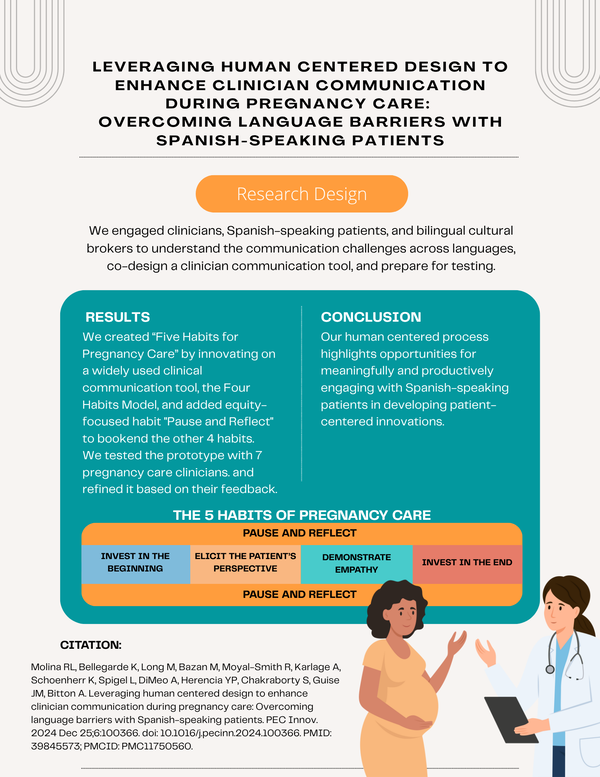
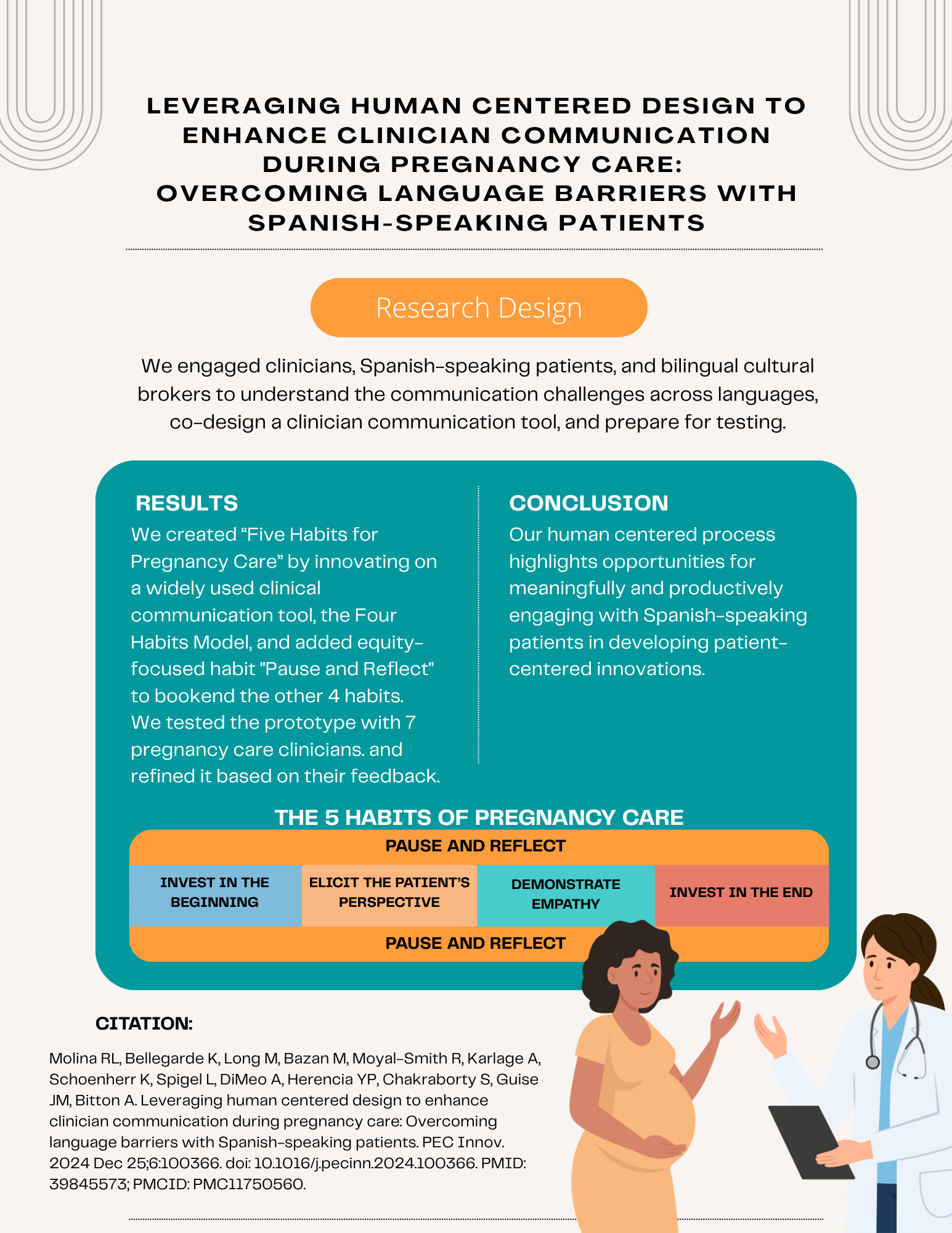
Molina RL, Bellegarde K, Long M, et al. Leveraging human centered design to enhance clinician communication during pregnancy care: Overcoming language barriers with Spanish-speaking patients.. PEC innovation. 2025;6:100366. doi:10.1016/j.pecinn.2024.100366

BACKGROUND: Engaging patients in quality improvement and innovation projects is increasingly important, yet challenges persist with involving patients who speak languages other than English. This article presents design activities our team used to engage Spanish-speaking patients and cultural brokers.

OBJECTIVE: To develop a clinician communication tool to enhance patient trust in pregnancy care clinicians, especially among minoritized populations who face language and cultural barriers, using human-centered design (HCD).

PATIENT INVOLVEMENT AND INNOVATION: We centered end-user experiences, including clinicians, Spanish-speaking patients, and Spanish-speaking cultural brokers, in our design process through multiple feedback sessions and modalities.

METHODS: We used a HCD process to understand the problem, co-design a tool, and prepare for testing of a clinician tool. Design activities included a critical literature review, user interviews, design principles, solution sketching, rapid cycle feedback with subject matter experts, and field experience with pregnancy clinicians.

RESULTS: We innovated on a widely used clinical communication tool, the Four Habits Model, and developed the Five Habits for Pregnancy Care to support pregnancy care clinicians in building trust by bridging cultural and language differences. We added an equity-focused habit "Pause and Reflect" to bookend the Four Habits. We refined the tool to meet different needs across pregnancy care visits based on feedback from 7 clinicians.

DISCUSSION: We applied equity principles in a HCD process to understand a problem, co-design a tool, and prepare for testing by engaging with patients and cultural brokers in Spanish. Balancing the differing approaches for designers and researchers yielded important insights for enhancing equitable processes and outcomes in healthcare improvement.

PRACTICAL VALUE: Communication tools designed with and for minoritized populations are critical for improving trust in all patient-clinician dyads during pregnancy care.


ssssss
English / Spanish
See also: Language Access
Rivera L, Butler H, Salinas KE, et al. Communication Preferences During Pregnancy Care Among Patients With Primary Spanish Language: A Scoping Review.. Women’s health issues : official publication of the Jacobs Institute of Women’s Health. 2024;34(2):164-171. doi:10.1016/j.whi.2023.08.008

BACKGROUND: Qualified language service providers (QLSPs)-professional interpreters or multilingual clinicians certified to provide care in another language-are critical to ensuring meaningful language access for patients. Designing patient-centered systems for language access could improve quality of pregnancy care.

OBJECTIVE: We synthesized and identified gaps in knowledge about communication preferences during pregnancy care among patients with Spanish primary language.

METHODS: We performed a scoping review of original research studies published between 2000 and 2022 that assessed communication preferences in Spanish-speaking populations during pregnancy care. Studies underwent title, abstract, and full-text review by three investigators. Data were extracted for synthesis and thematic analysis.

RESULTS: We retrieved 1,539 studies. After title/abstract screening, 36 studies underwent full-text review, and 13 of them met inclusion criteria. Two additional studies were included after reference tracing. This yielded a total of 15 studies comprising qualitative (n = 7), quantitative (n = 4), and mixed-methods (n = 4) studies. Three communication preference themes were identified: language access through QLSPs (n = 7); interpersonal dynamics and perceptions of quality of care (n = 9); and information provision and shared decision-making (n = 8). Although seven studies reported a strong patient preference to receive prenatal care from Spanish-speaking clinicians, none of the included studies assessed clinician Spanish language proficiency or QLSP categorization.

CONCLUSIONS: Few studies have assessed communication preferences during pregnancy care among patients with primary Spanish language. Future studies to improve communication during pregnancy care for patients with primary Spanish language require intentional analysis of their communication preferences, including precision regarding language proficiency among clinicians.

See also: Language Access
Bolt LM, Jiménez EH, Molina RL, Schreier AL. Conservation education initiatives for elementary school students at La Suerte Biological Research Station, Costa Rica.. Folia primatologica; international journal of primatology. 2024;95(4-6):271-281. doi:10.1163/14219980-bja10020

Maderas Rainforest Conservancy (MRC) is a conservation non-profit organization that protects forests, offers primate field schools, and leads community outreach initiatives at sites in Central America, including La Suerte Biological Research Station (LSBRS) in Costa Rica. In 2018, MRC started Aula Verde, a conservation education initiative for elementary school students aged 5-12 at LSBRS. Groups of children from elementary schools and communities located within 50 km have visited LSBRS from 2018-2023 to participate in the 1.5-2 hour Aula Verde workshop, which consists of (1) an interactive lecture on conservation, (2) a guided forest walk, and (3) a snack, gift bag, and tree seedling for each participant. Workshops are funded by international donations to MRC and cost US $8-16 per student. Aula Verde has been successful, with multiple schools and communities making repeat visits, students' families beginning to recycle their garbage and joining a WhatsApp group about conservation education that MRC staff initiated and lead, and teachers reporting improved learning outcomes for students who participate in the workshops. The success of Aula Verde is largely due to the ecological expertise and strong community ties of LSBRS staff. While the COVID-19 pandemic decreased Aula Verde offerings from 2020-2023, we expect workshops to resume at full capacity in 2024. In the future, MRC hopes to expand Aula Verde's outreach to all children aged 5-12 living within 50 km of LSBRS.

See also: Global Health
Gama ZA da S, de Lima MTS, Semrau KEA, et al. Implementation of the WHO Safe Childbirth Checklist: a scoping review protocol.. BMJ open. 2024;14(5):e084583. doi:10.1136/bmjopen-2024-084583

INTRODUCTION: The WHO Safe Childbirth Checklist (WHO SCC) was developed to accelerate adoption of essential practices that prevent maternal and neonatal morbidity and mortality during childbirth. This study aims to summarise the current landscape of organisations and facilities that have implemented the WHO SCC and compare the published strategies used to implement the WHO SCC implementation in both successful and unsuccessful efforts.

METHODS AND ANALYSIS: This scoping review protocol follows the guidelines of the Joanna Briggs Institute. Data will be collected and reported according to the Preferred Reporting Items for Systematic Reviews and Meta-Analyses extension for Scoping Reviews report. The search strategy will include publications from the databases Scopus, PubMed, Embase, CINAHL and Web of Science, in addition to a search in grey literature in The National Library of Australia's Trobe, DART-Europe E-Theses Portal, Electronic Theses Online Service, Theses Canada, Google Scholar and Theses and dissertations from Latin America. Data extraction will include data on general information, study characteristics, organisations involved, sociodemographic context, implementation strategies, indicators of implementation process, frameworks used to design or evaluate the strategy, implementation outcomes and final considerations. Critical analysis of implementation strategies and outcomes will be performed with researchers with experience implementing the WHO SCC.

ETHICS AND DISSEMINATION: The study does not require an ethical review due to its design as a scoping review of the literature. The results will be submitted for publication to a scientific journal and all relevant data from this study will be made available in Dataverse.

TRIAL REGISTRATION NUMBER: https://doi.org/10.17605/OSF.IO/RWY27.

See also: Global Health
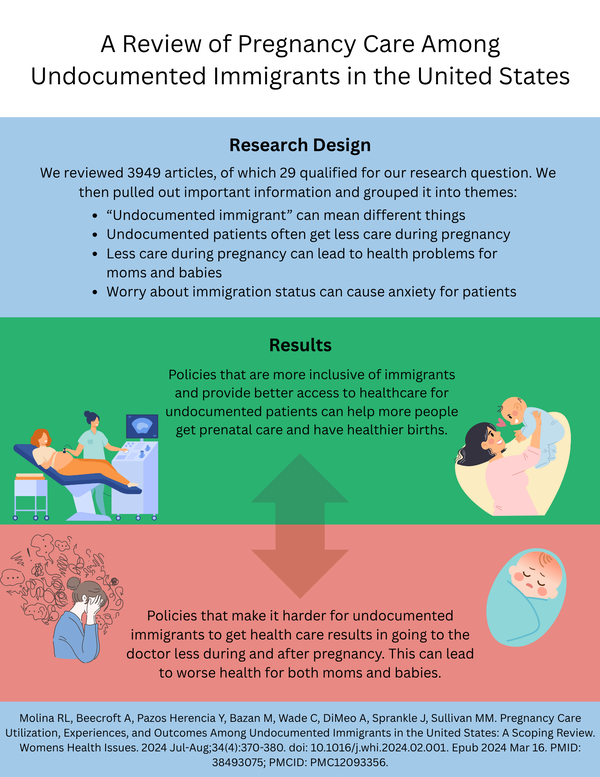
Molina RL, Beecroft A, Herencia YP, et al. Pregnancy Care Utilization, Experiences, and Outcomes Among Undocumented Immigrants in the United States: A Scoping Review.. Women’s health issues : official publication of the Jacobs Institute of Women’s Health. 2024;34(4):370-380. doi:10.1016/j.whi.2024.02.001

BACKGROUND: Undocumented immigrants face many barriers in accessing pregnancy care, including language differences, implicit and explicit bias, limited or no insurance coverage, and fear about accessing services. With the national spotlight on maternal health inequities, the current literature on undocumented immigrants during pregnancy requires synthesis.

OBJECTIVE: We aimed to describe the literature on pregnancy care utilization, experiences, and outcomes of undocumented individuals in the United States.

METHODS: We performed a scoping review of original research studies in the United States that described the undocumented population specifically and examined pregnancy care utilization, experiences, and outcomes. Studies underwent title, abstract, and full-text review by two investigators. Data were extracted and synthesized using descriptive statistics and content analysis.

RESULTS: A total of 5,940 articles were retrieved and 3,949 remained after de-duplication. After two investigators screened and reviewed the articles, 29 studies met inclusion criteria. The definition of undocumented individuals varied widely across studies. Of the 29 articles, 24 showed that undocumented status and anti-immigrant policies and rhetoric are associated with lower care utilization and worse pregnancy outcomes, while inclusive health care and immigration policies are associated with higher levels of prenatal and postnatal care utilization as well as better pregnancy outcomes.

CONCLUSIONS: The small, heterogeneous literature on undocumented immigrants and pregnancy care is fraught with inconsistent definitions, precluding comparisons across studies. Despite areas in need of further research, the signal among published studies is that undocumented individuals experience variable access to pregnancy care, heightened fear and stress regarding their status during pregnancy, and worse outcomes compared with other groups, including documented immigrants

English / Spanish 


See also: Immigration
DiMeo A, Logendran R, Sommers BD, et al. Navigating the Labyrinth of Pregnancy-Related Coverage for Undocumented Immigrants: An Assessment of Current State and Federal Policies.. American journal of public health. 2024;114(10):1051-1060. doi:10.2105/AJPH.2024.307750

Insurance coverage for prenatal care, labor and delivery care, and postpartum care for undocumented immigrants consists of a patchwork of state and federal policies, which varies widely by state. According to federal law, states must provide coverage for labor and delivery through Emergency Medicaid. Various states have additional prenatal and postpartum coverage for undocumented immigrants through policy mechanisms such as the Children's Health Insurance Program's "unborn child" option, expansion of Medicaid, and independent state-level mechanisms. Using a search of state Medicaid and federal government websites, we found that 27 states and the District of Columbia provide additional coverage for prenatal care, postpartum care, or both, while 23 states do not. Twelve states include any postpartum coverage; 7 provide coverage for 12 months postpartum. Although information regarding coverage is available publicly online, there exist many barriers to access, such as lack of transparency, lack of availability of information in multiple languages, and incorrect information. More inclusive and easily accessible policies are needed as the first step toward improving maternal health among undocumented immigrants, a population trapped in a complicated web of immigration policy and a maternal health crisis. (Am J Public Health. 2024;114(10):1051-1060. https://doi.org/10.2105/AJPH.2024.307750).

See also: Immigration