
Rotations
Residency in Obstetrics and Gynecology: Rotations
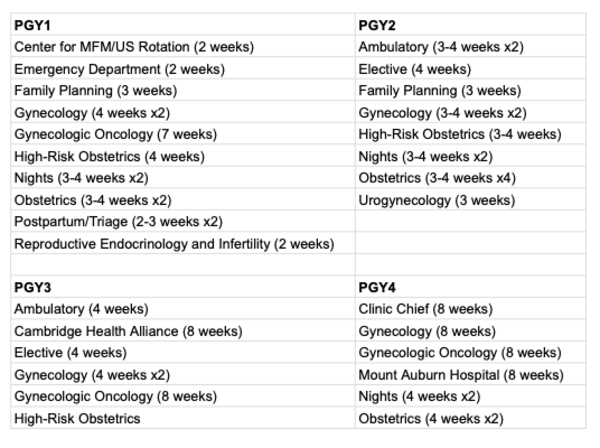
The majority of rotations during the four years of residency are either four or eight weeks in duration, each focusing on progressive responsibility within the framework of the ACGME milestones and sub-competencies. In the last year ("chief year") of your training, you will serve as the leader of each service.
Core Rotations
Gynecology
Residents spend eight weeks each year dedicated to the gynecology service. After learning the basics of ambulatory and in-patient gynecologic care, residents spend progressively more time in the operating room, which culminates with the chief residents supervising and teaching junior residents through procedures. While on the gynecology service, trainees spend time with our highly-skilled faculty in: minimally invasive gynecologic surgery, urogynecology, colposcopy and vulvar clinics, and transgender health. Each resident will be FLS-certified by the time they graduate.
Gynecologic Oncology
Residents spend eight weeks (24 weeks total) during their PGY 1, 3, and 4 years on Gynecologic Oncology. During the rotation, residents experience the full breadth of oncological care. Residents discuss each patient’s clinical course and treatment options at a weekly Gynecologic Oncology Tumor Board — a multidisciplinary conference attended by division members, as well as pathologists, radiologists, medical oncologists, and radiation therapists. Residents participate in genetic cancer counseling sessions and medical chemotherapy ambulatory management. Clinical education also includes simulated surgical practice and assisting the oncology faculty in the operating room.
Obstetrics
Residents will spend two four-week blocks in the PGY 1, 2, and 4 years on Labor and Delivery, where approximately 5,300 births take place every year. During this rotation, residents perform vaginal, cesarean, and operative assisted vaginal deliveries while working with the faculty practices. Residents learn to triage, oversee a busy service, and coach patients through their deliveries.
High Risk Obstetrics
Residents work on this expanding service for four weeks during the PGY 1 and 2 years and eight weeks during PGY 3. During this rotation, residents treat patients from all over New England, thanks to community affiliations and our maternal transport program. Time is spent in the Center for Maternal-Fetal Medicine diagnosing and counseling patients with complicated pregnancies, as well as on the floors and on Labor and Delivery assisting in high-risk deliveries. Additionally, residents will treat and operate on patients from our New England Center for Placental Disorders, many of whom require cesarean hysterectomies.
Nights
Each resident spends two four-week blocks per year on the Nights rotation working closely with three of their co-residents. The first-year resident manages all post-operative and non-obstetrical inpatients. The second-year resident begins to strengthen their leadership skills by running the board on labor and delivery and participating in cesarean sections. The third-year resident guides the first-year resident, participates in operative deliveries, and attends hospital-wide consults. The chief resident on Nights oversees the entire patient census, provides guidance to the PGY 2, attends chief service patient deliveries and urgent surgeries, and acts as educator to the junior residents and students.
Specialty Rotations
Cambridge Health Alliance
The rotation at Cambridge Health Alliance is an eight-week rotation in the PGY 3 year that allows the resident to practice as a generalist practitioner in the community setting, while collaborating with Cambridge health alliance faculty, Family Medicine residents, , and Physician Assistants. During this rotation, the residents begin to work more autonomously in preparation for their chief year, when they will assume advanced leadership roles as chief residents.
Clinic Chief
Clinic Chief is an eight-week rotation in the chief year of the program during which the chief residents have their own weekly pre-operative clinic from which patients will be booked for surgery. The resident serves as the primary surgeon under the guidance of our dedicated surgical teaching staff. Additionally, the clinic chief is the point person for junior residents and nursing in the ambulatory setting.
CMFM (Ultrasound)
This two-week rotation takes place during the PGY 1 year in the Center for Maternal-Fetal Medicine. In order to hone their obstetrical ultrasound skills, the resident works closely with faculty and sonographers. By the completion of this rotation, residents are proficient in basic obstetrical ultrasounds and have gained additional experience with advanced obstetrical ultrasounds.
Elective
Each resident spends a four-week block in the PGY 2 and PGY 3 years (eight weeks total) during which they have protected time to work on scholarly projects, travel abroad for global health electives or pursue subspecialty electives at outside institutions locally or nationally.
Emergency Medicine
Each resident spends two weeks in their PGY 1 year working in the Emergency Department under the guidance of that program's leadership. This rotation expands the breadth of the residents’ knowledge and prepares them for urgent triaging and medical care beyond obstetrics and gynecology.
Family Planning
The Division of Family Planning offers two four-week rotations in the PGY 1 and PGY 2 years as part of the national Kenneth J. Ryan Residency Training Program. Residents learn to provide all methods of contraception and to address the family planning needs of patients with complex medical conditions. Residents may perform ambulatory procedures including manual vacuum aspiration, dilation and evacuation, and intrauterine device and contraceptive implant insertions.
Ambulatory
The Ambulatory rotation consists of a four-week block in the PGY 2 and PGY 3 years (eight weeks total) where the resident is immersed in subspecialty ambulatory clinics, such as colposcopy, gynecologic minor procedures.
Mount Auburn Hospital
Each PGY 4 resident spends eight weeks working alongside the faculty gynecologists and urogynecologists at our affiliate Mount Auburn Hospital in Cambridge. Residents enhance their surgical skills by assisting on complex gynecologic surgeries with an emphasis on minimally invasive vaginal and robotic approaches.
Reproductive Endocrinology and Infertility
During this four-week rotation, PGY 1 residents participate in all clinical services at the program’s principal site, Boston IVF. Boston IVF is one of the largest assisted reproductive technology programs in the United States, with faculty assisting in more than 35,000 births. The residents’ clinical experience includes evaluation and management of new patients and those returning for consultation. Residents acquire skills performing ultrasound, sonohysterograms, and hysterosalpingograms; they also assist in ambulatory surgery and advanced reproductive technology procedures.
Global Health Track
Several OBGYN trainees have been accepted into the BIDMC-sponsored Global Health Program. This program funds four to six residents per year to attend one of two Harvard Global Health academic courses. Additionally, global health curriculum sessions are held throughout the year and are intended to provide a framework for addressing global health disparities, prepare residents for their time abroad, and train them to be effective clinicians in system- and resource-poor settings.
