
Internship Year
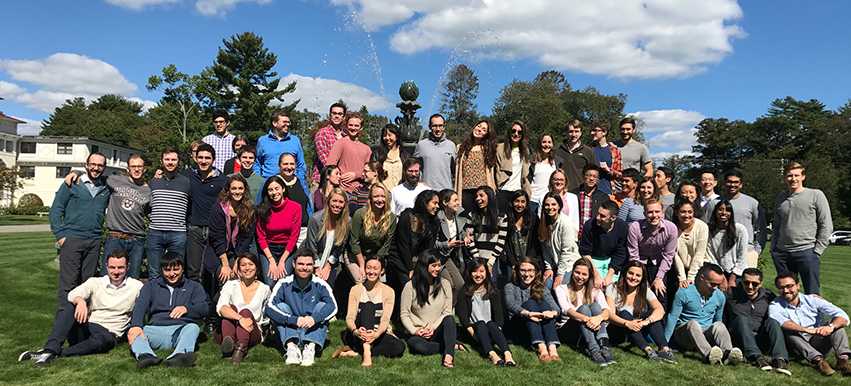
Our Interns
The internship year (PGY-1) emphasizes the care of patients in general inpatient medicine, intensive care medicine, oncology, cardiology, liver/kidney service, emergency medicine and ambulatory medicine utilizing both campuses and selected outside sites such as the Dana-Farber Cancer Institute and VA Medical Center.
Working as part of a 2-4 physician team which includes an overseeing resident, attending staff, and often medical students, interns gain experience in the management of patients with a broad range of medical diseases. Throughout intern year, interns maintain a longitudinal continuity clinic experience where they develop a panel of their own primary care patients. During most of the year, with the exception of intensive care rotations, interns will have clinic one half-day per week. Distributed throughout the year are four “ambulatory blocks” of two weeks duration. During this time, the interns are in their continuity clinic every afternoon and attend outpatient specific didactic lectures during the morning hours.
As members of the Harvard faculty, interns play an important role in teaching, both of their peers and of rotating medical students. While on the medical wards, interns provide daily clinical guidance and teaching to third and fourth year medical students. As part of the ambulatory care curriculum, interns will also have the opportunity to lead pre-clinic conferences. During the year, there are special intern-only educational activities including the twice-weekly Intern Report, monthly intern forum sessions and bi-annual 24-hour intern retreats.
One Year Preliminary Training in Internal Medicine
Each year several internship positions are reserved for applicants desiring one year of rigorous internal medicine training (Preliminary year) prior to postgraduate training in another discipline. Preliminary and Categorical Interns share the same kind of rotation schedule and are exposed to training in the same areas. Preliminary interns may elect to have a continuity clinic experience but are not required to do so.
Intern Schedule
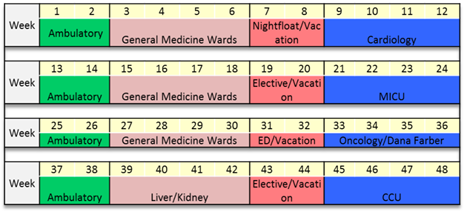
BIDMC’s Intern Year is organized as an innovative “4+2” schedule. This means that 4 week inpatient rotations are sandwiched between 2 weeks of non-call rotations such as ambulatory and elective. This format creates the ideal balance of intensity through the year and guarantees you’re never too far from a golden weekend.
An example schedule is included below which includes 48 weeks of “4+2”. The other 4 weeks of the year are encompassed by holidays and an intensive orientation period where interns get accommodated to their continuity clinic.
Intern Orientation Program
Our novel Intern Orientation Program (IOP) was created to help interns to adjust to structure and systems of their new role, especially in their ambulatory clinics. This orientation is designed to help interns, who often having variable experience in primary care during medical school, rapidly acclimate to the outpatient setting. At the beginning of the first year, all interns begin with two weeks of either ambulatory rotation or inpatient wards, and then switch places after two weeks. During their time in the ambulatory IOP, interns are oriented to their specific clinic site and have half-day patient care sessions 3-4 times per week. They are also provided with didactic lectures on common outpatient clinical and systems topics. The IOP experience has been highly reviewed by both our interns and faculty.
Opportunities Unique to Internship
Intern Forum: Each month small medical firm based groups of interns meet over lunch with a dedicated group of nurses and social workers; these sessions create a relaxing and safe environment for interns to reflect on and share their experiences.
Intern Retreats: In the fall of Intern year, all of the interns go off-campus for an overnight retreat in a beautiful ocean-front setting. The retreat is a time to bond with colleagues and faculty and to reflect on their experiences. In the spring we hold a day-long retreat to prepare for interns for the transition to their role as residents and team leaders. The retreat is capped by an end of year celebration for interns.
Career Development
Our program offers a series of learner-centered tracks, pathways and supplemental educational experiences that complement our core educational curriculum, allowing learners to identify and participate in advanced educational and career development programs.
We offer interns the opportunity to apply to one of four formal tracks:
- Physician-Scientist Track
- Global Health Track
- Primary Care Track
- Clinician Educator Track
- Social Justice Pathway
- Digital Education Track
Social Events
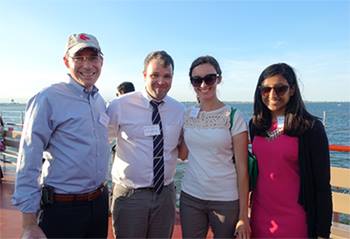
BIDMC residents work hard! We do not allow the year to pass without celebrating the passage of time, holidays and accomplishments. Interns begin their year a tour of the Boston Harbor aboard a harbor cruise-ship. An annual holiday party is held for all housestaff in December where hospital-wide overnight coverage is provided by recent BIDMC graduates who remain in the Boston area. At the end of the year the interns are treated to the Sidel Dinner at the Harvard Club to mark their accomplishment and bid farewell to their preliminary-intern colleagues as they move on to their specialty residency programs. Senior residents are similarly celebrated with graduation events prior to moving on to fellowships, research positions and general medicine practice.
Wellness and Community Groups
BIDMC offers various wellness and community groups available for residents throughout their time in residency. These groups aim to promote community, provide resources and mentorship and additional training to support residents quality of life.
Moving on to Junior and Senior Years
The Junior and Senior Years of Internal Medicine Residency solidifies residents clinical and teaching skills by having juniors and seniors lead medical teams. Our program positions the resident as the primary leader and teacher of the medical team, and autonomy is one of the frequently cited positive attributes of our program. The junior and senior years also provide more elective time to sample subspecialty training in specific areas of interest.