
Primary Care Track
Training Internists in Outpatient Medicine
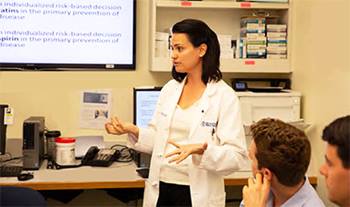
The innovative centerpiece of the Primary Care Track within the Internal Medicine Residency Program is the ambulatory long block, which is a six-month intensive experience during the junior and senior years. Unique in its structure, residents spend six consecutive months in their junior year, and again in their senior year, working in outpatient primary care and subspecialty clinics. They become adept in general outpatient clinical practice and develop expertise in their specific areas of interest, from addiction treatment to hypertension management to the care of individuals with HIV. During long block, residents serve as an "innovation lab" within our practice, learning about quality improvement and spearheading meaningful improvements in care delivery that have lasting change within the faculty-resident practice where they see patients. All residents participate in the Social Justice Pathway, and they may pursue additional training and experiential learning in areas including geriatrics, medical education, research, health care leadership, and sexual and gender minority care. The primary care long block offers residents unparalleled flexibility to shape their training in accordance with their self-identified educational goals as well as clinical and academic interests.
Our primary care program, which is over 40 years old, was one of the first in the country. Over the past decade, we have graduated 120 primary care residents, many of whom have become leaders in clinical medicine, education, and research.
Mission
The mission of our Primary Care Track is to train outstanding general internists who will provide future leadership as clinicians, educators, practice and quality innovators, and/or researchers in this evolving field.
What Makes Our Program Distinctive
Beth Israel Deaconess Medical Center has received two substantial grants that support innovation and leadership training in primary care:
- $2 million from the Center for Primary Care at Harvard Medical School through their Academic Innovations Collaborative to transform our ambulatory teaching practice into a patient-centered medical home
- $8 million from the Linde Family Foundation to teach primary care leadership and management skills to medical residents and fellows
Through these grants, Primary Care Track residents will have the opportunity to become integral members of the team involved in practice redesign and to participate in seminars and mentored projects to enhance their leadership and management skills. There may also be opportunities for loan forgiveness.
Primary Training Site
Healthcare Associates (HCA), our hospital-based teaching practice, is located in the Shapiro Clinical Center on the BIDMC East Campus. HCA is recognized by the National Committee for Quality Assurance (NCQA), as a Patient-Centered Medical Home and provides care to more than 41,500 patients. Our teams include more than 60 faculty physicians and 145 rotating medical housestaff, who work closely with nurse practitioners, clinical triage nurses, licensed practical nurses, clinical social workers, community resource specialists, pharmacists, medical assistants, and other support staff to provide multidisciplinary care. HCA faculty have expertise in chronic disease management, geriatrics, women's health, minority health, student health, HIV medicine, addiction medicine, preventive medicine, health policy, quality improvement, medical education, and health services research.
While many Primary Care Track residents choose Healthcare Associates as their primary training site, residents with specific interests in community health, LGBTQ+ health, veterans’ care, and private practice have the opportunity to select another primary training site and work at HCA as their second continuity clinic site.
Program Overview and Curriculum
The Primary Care Track provides a comprehensive ambulatory curriculum to all medical residents. It is presented over a three-year period and includes lectures, case-based discussions, physical diagnosis, and clinical skills workshops, and seminars. Primary Care Track residents receive additional curriculum for content that is germane to these areas.
Ambulatory Electives
An extensive array of both inpatient and outpatient electives are available during medical residency training to meet individual educational needs and career interests. Categorical residents have electives paired with practice weeks, while Primary Care Track residents have most electives incorporated into their ambulatory long blocks.
Practice Sites
Continuity practice sites include Healthcare Associates, BIDMC Affiliated Practice Groups, Bowdoin Street Health Center, Cambridge Health Alliance, Dimmock Community Health Center, and more. Additionally, there are continuity practice experiences for residents with a focused interest in other areas, including geriatrics, mind/body medicine, prison medicine, and palliative care.
Primary Care Events
Primary Care Interest Groups and Social Events
These formal and informal gatherings are designed to enhance collegiality among faculty and housestaff, and include a Primary Care Dinner and social events scheduled by the Primary Care Chief Medical Resident.
Society of General Internal Medicine Meetings
Primary Care Track residents are strongly encouraged to attend regional and national general medicine meetings and present a clinical vignette or research abstract. The Department of Medicine provides funding to defray the cost of one conference during residency training.
Mentorship and Career Counseling
Primary Care Track residents are matched early in their training with a primary care faculty mentor based on their interests. This mentor will meet with them regularly throughout the course of their residency training and provide professional guidance and support, as well as career counseling.
Primary Care Track FAQs
How does the Primary Care Track differ from the categorical training program?
Primary Care Track residents participate in two six-month ambulatory Long Blocks, which include additional clinic sessions at their primary continuity site, a second continuity site based on their individual interests, and required and elective subspecialty clinics. During Long Block, residents have a dedicated primary care curriculum, participate in the Social Justice Pathway, participate in an innovation project, and have opportunities for additional training and experiential learning in outpatient procedures, medical education, healthcare leadership, research, quality improvement, HIV medicine, and sexual and gender minority health. Primary Care Track residents receive regular mentorship and career counseling, and they are invited to primary care interest groups and social events. Primary Care Track residents have approximately the same number of general medicine inpatient rotations as their categorical program colleagues. They tend to have somewhat fewer specialty inpatient rotations and intensive care unit rotations.
We've recently published our findings about the effect of this immersive primary care training program on educational and clinical outcomes in the Journal of General Internal Medicine.
How do I apply for a position in the Primary Care Track?
There is a separate match for the Primary Care Track. We match four Primary Care Track residents annually. Up to two additional Primary Care Track slots are generally offered for interns in the categorical program, but there is no guarantee of placement.
How many residents in the Primary Care Track enter careers in primary care medicine?
Historically, over three-quarters of the Primary Care Track's graduates have entered primary care careers. Of those who choose to pursue subspecialty fellowships, many practice a mixture of general and subspecialty ambulatory medicine.
What types of jobs do people have after training?
Primary Care Track residents pursue positions that include clinical, educational, administrative, and research roles. Many, but not all, choose to join academic practices. Our graduates are currently on the faculty at Beth Israel Deaconess Medical Center, Massachusetts General Hospital, Brigham and Women’s Hospital, Boston Medical Center, Tufts Medical Center, Dartmouth Hitchcock Healthcare System, Yale University, Mt. Sinai School of Medicine, New York University, University of Chicago, Georgetown University Medical Center, Northwestern University, Stanford University, University of Alabama, University of California at San Francisco and Los Angeles (UCSF and UCLA.) and many others. Other graduates work in community health centers in Boston, New York, San Francisco and in many other places across the country.
What if I choose to do a fellowship?
While the Primary Care Track is designed to prepare residents for careers in primary care, some graduates have decided to pursue subspecialty training. We consider geriatrics and palliative care as part of primary care training, and provide enriched experiences for residents interested in these pathways. Primary Care Track residents are equally competitive as categorical program residents in fellowship matches.
How To Apply
To learn more, please e-mail:
Primary Care Program Director Dr. Kelly Graham
or
Associate Primary Care Program Director Dr. Katherine Wrenn