
Junior & Senior Year
Junior and Senior Years
The Internal Medicine Residency solidifies clinical and teaching skills by having juniors and seniors lead medical teams. Junior residents supervise interns during their Internship Year and students on general medical services and in the medical and cardiac intensive care units, which continues with increasing autonomy in the senior year. Autonomy is one of the frequently cited positive attributes of our program. Our culture espouses the resident as the primary leader and teacher of the medical team to prepare residents for fellowship.
The junior and senior years also provide more elective time to sample subspecialty training in areas of interest and offers research opportunities. The elective opportunities are diverse, ranging from traditional specialty rotations to primary care in Provincetown to Healthcare for the Homeless. The Global Health Track, Clinician-Educator Track and Social Justice Pathway are other chances to gain specific training and experiences, and the curricula for these tracks are more intensive during the junior (Post-Graduate Year 2) and senior (Post-Graduate Year 3) years.
The year is structured in a 3+3 “Alternating Call and Electives” (ACES) model, with general medicine, specialty wards, and critical care rotations alternating with elective, ambulatory, and nighfloat weeks.
Other rotations available in the junior and senior years are:
- Stoneman Quality Improvement elective: one of the first resident QI rotations in the nation to teach residents QI skills, while having them participate in meaningful projects at the hospital
- Hospital medicine elective: an experiential rotation covering the administrative, financial, and academic aspects of hospital medicine
- Medical Consult: providing medical and pre-operative consultation on non-medical inpatient services
- Procedures rotation: an intensive clinical exposure performing procedures on multiple services under supervision
- Area of Concentration: protected time to work on research (basic science, clinical, QI, or education) or other scholarly project
Teaching as a Resident
Teaching is an important privilege and responsibility of all residents; as such, they are viewed as some of the core teachers within the Department of Medicine. At the same time, observation of resident teaching by Medical Firm Chiefs, clinical attendings and Chief Residents is a routine aspect of the way we train residents to be better teachers.
Leading inpatient medicine rounds: Residents run ward rounds, with the attending hospitalist providing support as necessary. Medical students and interns look to the resident as the primary decision-maker for the patients on their service.
Leading teaching attending rounds: During every rotation on the medical wards, each resident will lead at least one teaching session.
Small group presentations: During ambulatory weeks, residents will lead a majority of the pre-clinic conferences, typically presenting either a challenging ambulatory case or ambulatory-based topic. Once during residency, each junior resident will also present an article at ambulatory journal club to a small group of their peers.
“Senior” Teacher Rotation: Residents may choose to do the 1-2 week senior teacher elective as junior or senior residents.
Teaching activities include:
- Weekly lectures to the 3rd year medical students rotating on the inpatient medicine wards
- Weekly lectures to the 4th year medical students rotating on the sub-internship service
- Running one intern report under the mentorship of the Chief Residents
- Precepting interns in continuity clinic, under the supervision and mentorship of the primary care faculty.
- Working with the Director of Simulation in simulation-based teaching for students and fellow residents.
Foundations of Medical Education Course
This novel week-long medical education course is designed for residents who want even more opportunities to become an exceptional medical educator. The Foundations of Medical Education Course utilizes a "flipped classroom" model to stimulate group discussions and learning on common topics such as adult learning theory, cognitive learning theory, feedback, small group teaching, bedside teaching, and ambulatory teaching. In addition, during this course, residents have ample opportunity to practice these skills and receive feedback from education leaders.
Preceptors in Practice of Medicine: This is the course for pre-clinical Harvard medical students, which lays the foundation for clinical medicine. Each year a number of our residents participate either longitudinally or during some weeks.
Tutorial Leaders for Pathophysiology: Residents can lead problem-based tutorials in the pathophysiology course at HMS for first year students.
West Roxbury VA Chief Resident: Some of our senior residents are selected each year to serve as a Primary Care Chief Resident at the West Roxbury VA Medical Center. Duties include administrative work, numerous teaching conferences including resident reports, and bedside teaching. They also help precept ambulatory care visits at the West Roxbury outpatient clinics.
Ambulatory Long Block (Primary Care Track)
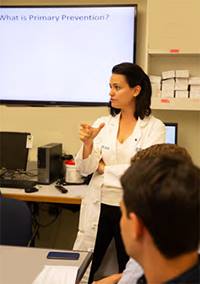
The Primary Care Track curriculum is designed to increase continuous time spent in the ambulatory setting and teach residents about innovations in primary care by allowing residents to spend 6 consecutive months in the outpatient setting during their junior and senior years. In addition, residents participate in unique projects focused on practice redesign and quality improvement, and receive leadership training focused on the primary care experience.
Senior Teacher
During the third year of residency, residents may select an elective called "Senior Teacher." During this three week block, residents not only lead didactic lectures for medical student and interns but also precept interns in the Health Care Associates Primary Care Clinic. This rotation allows residents the experience to teach and guide junior learners as well as refine their own teaching skills.
Mount Desert Island

Each year, a group of junior and senior residents travel to the beautiful Maine coast for a 1-week basic science immersion experience in comparative physiology.
The goals of the Mount Desert Island course are to increase appreciation for physiology and enhance incorporation of basic pathophysiology into teaching and clinical roles on the general medical ward and ICU rotations. The course, held at Mount Desert Island Biologic Laboratories, is comprised of multiple modules (for example, water metabolism, NaCl excretion, hematology/coagulation, cardiovascular physiology), each with basic science experiments utilizing aquatic species, and accompanied by clinical correlation discussions. After each module, residents present their findings to one another, with specific aims for subsequent groups to investigate. Beyond the laboratory experience, residents are encouraged to enjoy all the Maine coastline has to offer, including rock climbing and kayaking.
The Research Course
In addition to the Physician-Scientist Track, the program offers a Research Course to junior and senior residents. The Research Course is a two-week introduction to research methods and resources, grant and paper writing, and career development. Residents develop a research project in workshops with other residents and faculty mentors, and receive seminars on study design, research methodology, and local research resources. This course has helped many residents become true physician-scientists and physician-researchers. Our program also provides financial support and clinical coverage to attend national conferences.
Quality Improvement
The BIDMC Internal Medicine residency program has been a national leader in quality improvement for over a decade. We practice in a hospital and department that values the highest quality care and consistently desires to do better. QI and safety training have been part of the BIDMC core curriculum since 2001. In the junior and senior years, all residents complete the Stoneman Elective under the mentorship of our Patient Safety Core Faculty. These residents participate in ongoing safety and quality activities at the institutional and departmental levels, perform root cause analyses, and participate in hands on project work.
For residents who want further QI training, we offer a one-week intensive "QI Retreat." A dozen residents each year participate in this multidisciplinary course that teaches advanced QI skills through analysis, design, and improvement of a multidisciplinary project. Many residents do additional scholarly QI work through our comprehensive research pathway and opportunities as described elsewhere.
Junior & Senior Resident Ambulatory Program
The ambulatory care experience for all junior and senior residents includes:
- Weekly continuity clinic
- Multi-disciplinary support staff
- Mentoring relationship with a single preceptor
- Three-week ambulatory block rotations
- Exposure to an ambulatory medicine curriculum
- Ambulatory elective experience chosen from a vast array of subspecialty clinics and community-based settings
- An optional primary care track
The Junior and Senior Ambulatory Core Curriculum
The junior and senior ambulatory core curriculum addresses the knowledge, skills and attitudes that internists must attain to become competent practicing physicians. The curriculum is presented through an organized didactic program including conferences, lectures, Grand Rounds and case studies scheduled during three-week long ambulatory block rotations. General internal medicine faculty members, BIDMC subspecialists, and senior housestaff serve as seminar leaders, lecturers and discussion facilitators.
Conferences Core Curriculum
The Ambulatory Care Conference is a weekly lecture series focusing on topics pertinent to the practice of outpatient medicine. Discussion centers on concepts and understanding of disease management, and treatment options. Speakers include general internal medicine faculty as well as various BIDMC subspecialists.
The ambulatory didactic conference provides a foundation of core concepts relevant to the practice of general internal medicine and includes topics in medical orthopedics, women's health, geriatrics, and complementary medicine, to name but just a few.
The preventive medicine series focuses on principles of maintaining health and preventing disease, disability, and death. The basic components of the preventive medicine series include biostatistical principles and methodology; epidemiological principles; recognition and control of environmental and occupational hazards; social, cultural, and behavioral factors in medicine; and application of preventive principles and outcome measures in clinical practice. Conferences are interactive and include a critical appraisal of the literature as well as analysis of the utility of screening for specific disease entities.
The Behavioral Medicine Series teaches internists about common behavioral health disorders. Emphasis is placed on learning methods of behavior modification, risk assessment, and risk modification. In addition, medical conditions and problems that raise attitudinal or difficult feelings for providers are presented and explored.
The Brief Clinical Review Series addresses common clinical issues in an evidence-based fashion.
The HCA Journal Club Curriculum promotes evidence-based medicine and critical literature review in the resident's practice. The objective of the program is to study how clinical questions (such as diagnosis, prognosis, and treatment) are answered by solid scientific research involving populations or groups of patients. Participants learn to assess the validity of published evidence by understanding basic clinical research strategies, such as study design and statistical measurement, as well as gaining critical literature appraisal skills.
Conferences Core Curriculum Supplements
The resident-led conference series allows residents the opportunity to share their learning experiences in ambulatory medicine with their colleagues while developing their teaching skills. A designated resident chooses a topic from his/her assigned ambulatory elective to present at this conference.
Post-Practice Conference takes place twice a week for residents while they are on their outpatient block rotation. It is led by the Primary Care Chief Resident and the attending of the month and includes a case-based approach to common problems in the outpatient setting.
This series provides residents interested in entering the field of primary care medicine the opportunity to receive guidance, information, and advice on how to approach and manage their own job search.