
Research Opportunities
Program and Faculty
The Internal Medicine Residency Program at BIDMC offers residents the opportunity to explore different roles within the medical field. Whether residents aspire to become academic internists, specialists, clinicians, educators, researchers, or academic scholars, this program is designed to provide them with the tools and resources they need to succeed in their chosen path.
For residents interested in pursuing a career in research, our program offers an array of research opportunities for growth and development. With over $190 million in Department of Medicine research funding annually, residents can work on cutting-edge research projects and receive mentorship from renowned investigators in the field. Learn more about Internal Medicine research programs and meet our dedicated core research faculty below.
Core Research Faculty
Our dedicated core research faculty includes Drs. Christina Wee and Kenneth Mukamal, Associate Program Directors and Directors of the Resident Research Curriculum. They assist Internal Medicine residents with identifying potential mentors and projects across the research spectrum. Their expertise spans basic, translational, clinical, and population-based research, allowing them to foster connections between residents and mentors in every domain of biomedical research.
Devoted Elective Time for Research
Residents are strongly encouraged to do research during elective Area of Concentration (AOC) time. Most residents who elect to do research choose a mentor and project toward the end of the PGY1 year or the beginning of the PGY2 year. To find the right mentor and project, residents can meet with Drs. Wee or Mukamal.
Working with their mentors, junior and senior residents prepare a short proposal for elective research. At least two faculty members unconnected with the project review each proposal and offer formal feedback NIH-style, helping to identify new opportunities or potential pitfalls and to develop residents' skills in grant writing and revision. A major block of elective time for research is available in the PGY2 and/or PGY3 years. About 70% of residents will take advantage of this protected research time.
Research Infrastructure for Residents
The Department of Medicine devotes considerable infrastructure to support resident research:
- Partial funding for an expert biostatistician as a consultant to residents
- Computer resources in the housestaff lounge include several statistical packages, EndNote, RedCap, and the full MS Office suite, among others
- Core facilities in genomics, proteomics, and imaging are fully available to residents
- The Harvard Clinical and Translational Research Center, or Harvard Catalyst, supports resident research with clinical, laboratory, statistical resources and online training, and financially supports some resident projects
- Free assistance, tutorials, and unparalleled access to digital resources are available at the Harvard Countway Medical Library
Research Course
The resident research course is a two-week introduction to research methods and resources, grant and paper writing, and career development. Residents develop a research project in workshops with other residents and faculty mentors, and receive seminars on study design, research methodology, and local research resources.
Social Justice Pathway
The mission of the Social Justice Pathway is to equip trainees to be change agents in our healthcare system and society. The Social Justice Pathway is designed for residents who aim to be leaders in advocacy work. Beginning in their PGY2 year, residents will participate in a three-pronged curriculum which includes an immersive didactic course in their PGY2 year, local community outreach and advocacy work and a longitudinal research or innovations project.
Physician-Scientist Track
The dedicated Physician-Scientist Track aims to support the research careers of MDs and MD/PhDs committed to clinical, translational, and/or basic science investigation and clinical practice. Renowned Harvard faculty members provide mentorship and career guidance as residents develop their research interests and career paths.
Resident Research Presentations
Residents have the opportunity to present their research in several venues. The entire Department of Medicine gathers for Resident Research Day, where every resident involved in research presents a poster describing their work. The final Medicine Grand Rounds of each year is devoted to resident research. In addition, the Department provides funding for residents to present their work at national meetings.
Medical Grand Rounds
During the concluding Medical Grand Rounds of the academic year, three residents have the opportunity to present their work to the entire Department of Medicine.
Research Day
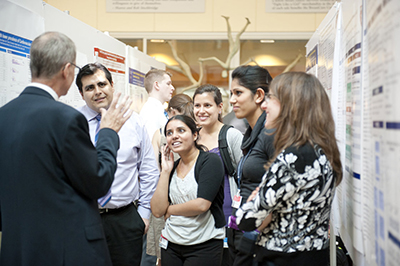
During Research Day every spring, residents who have done research, educational or service projects present their results in a poster session attended by the entire department. The event is a festive celebration with wine, hors d'oeuvres and live jazz.
Presentations at National Meetings
The Department of Medicine supports travel for residents to present at national meetings.
Resident Publications
The majority of our residents publish research results, case reports, or review articles during their residency. On average, the residents publish 70+ articles every year, including in publications such as The New England Journal of Medicine, JAMA, Circulation, JAMA Internal Medicine, and other high-quality journals.
Resident Research Opportunities
The American Board of Internal Medicine (ABIM) Research Pathway allows residents to substitute a year of clinical training in a subspecialty for the PGY3 year of the residency - in essence, to "short track" into fellowship training. Residents with a PhD or equivalent advanced scientific training may qualify for the Pathway.
There are many opportunities available for formal advanced research training at BIDMC and affiliated institutions, all designed to integrate with fellowship training. Programs include Master's Program in Clinical and Translational Investigation (MPCTI), Clinical and Translational Scientist Certificate Program, Summer Program in Clinical Effectiveness and NIH Loan Repayment Programs.
Each year, a group of junior and senior residents travel to Mount Desert Island in Maine for a 1-week basic science immersion experience in comparative physiology. The goals of the course are to increase appreciation and understanding of physiology and enhance residents' ability to incorporate key concepts in pathophysiology into their teaching and clinical roles within the medical center.